KBB magazine’s recent webinar “The Essential Role of Lighting in Residential Design” provided insight on…
Read More →
KBB magazine’s recent webinar “The Essential Role of Lighting in Residential Design” provided insight on…
Read More →
A long-time High Point Market exhibitor, Ngala Trading will open a Dallas Market Center showroom…
Read More →
New exclusive Consumer Insights Now research shows this is a need-driven generation that likes to…
Read More →
The company says its “residentially inspired” destination will offer an immersive way to experience Kichler.…
Read More →A seminar on designing for well-being inspired LNN Style Editor Julie A. Palm to showcase biophilic fixtures that tap into the universal desire to be immersed in nature.
By Julie A. Palm
Replete with nature motifs and featuring fixtures that create dappled light, Broche is one of Crystorama’s bestselling lighting collections.
Experts in neuroaesthetics and biophilia would not be surprised.
Not familiar with neuroaesthetics? It’s a field of science that studies psychological responses to art, objects, design and architecture. In the world of home furnishings, neuroaesthetics can be used by manufacturers, designers and retailers to help people choose products and create rooms that improve their physical and emotional health.
Neuroaesthetics has several aspects. A foundation is that, as humans, we are drawn to nature, whether materials like wood and stone or the rhythms and patterns of the natural world, including the flow of water and that dappled light created by some of Crystorama’s Broche fixtures. We sometimes talk about this as the biophilic component of neuroaesthetics.
Humans are evolutionarily wired to be drawn to nature. For instance, dappled light reminds us of the tree canopy and the protection it offers, according to people who study such things.
Bill Browning, Hon. AIA, LEED AP, co-founder of Terrapin Bright Green, is an expert in biophilic design and has a book on the subject, 14 Patterns of Biophilic Design: Improving Health and Well-Being in the Built Environment. He spoke about the subject last spring at High Point Market. Read more here.
But back to Crystorama. Ryan Ranzino, vice president of sales for Crystorama, talked about the Broche collection and his company’s approach to neuroaesthetics during a webinar last week on January 21. The seminar, “Designing for Well-Being: The Science Elevating Home Furnishings and Design,” was sponsored by Science in Design, which teaches interior designers and others about the positive effects of beauty, nature and fine design on people’s well-being.
Ranzino was joined on the panel by Jason Phillips, CEO of Phillips Collection, and Justin Alves, head of design at web design firm Jola. Mike Peterson, founder of Science in Design, moderated the discussion.
Ranzino told the webinar participants that Crystorama has marketed the Broche collection as bringing “the outdoors in.”
The Broche six-light chandelier is indicative of the collection’s vibe. The inverted pendant is made of hand-painted wrought iron leaves delicately wrapped around the frame to create a warm, inviting glow. Shown here in Antique Gold, it’s also available in Antique Silver and Matte White.
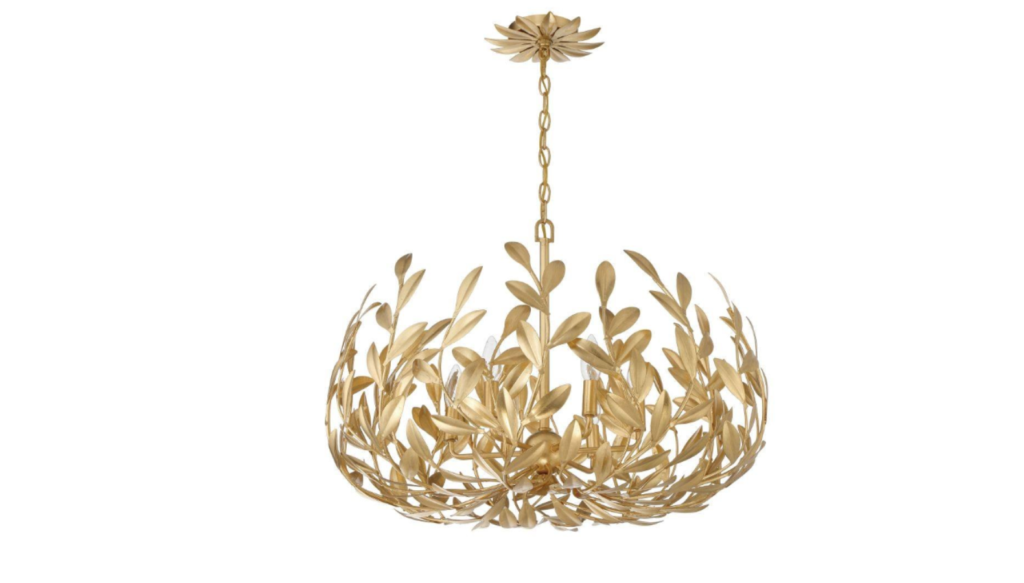
“But many of these (neuroaesthetic) principles and design elements also show up organically for us in the way we think about proportion, material, finish or light output. (With light output,) we place close attention to how the light impacts the room, how it interacts with the pace, softens a room, creates rhythm,” Ranzino told webinar participants. “We also use natural materials like handblown glass.”
Inspired by the webinar and Ranzino’s insights, we thought we’d look at other fixtures that capture some neuroaesthetic design principles, especially those related to biophilia. They range from organic and earthy to sophisticated and ethereal, offering options for a wide variety of consumers.
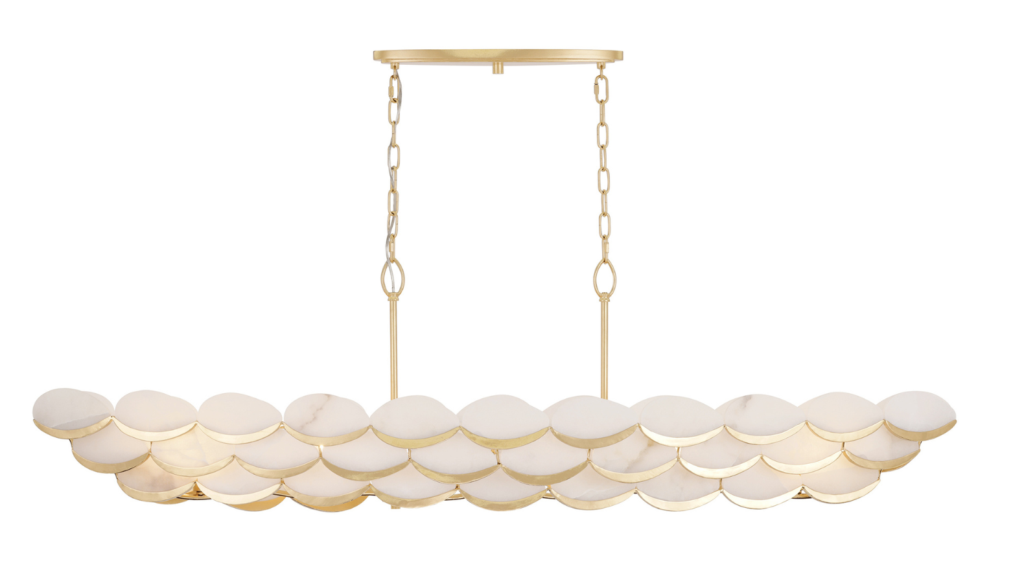
As humans we’re drawn to water. The High Tide linear pendant from Varaluz is made of Spanish alabaster ovals that shimmer like ocean waves. Or maybe, the company says cheekily, they represent “chic little fish scales.” Either way, High Tide speaks to our affinity for the movement of – and within – water.
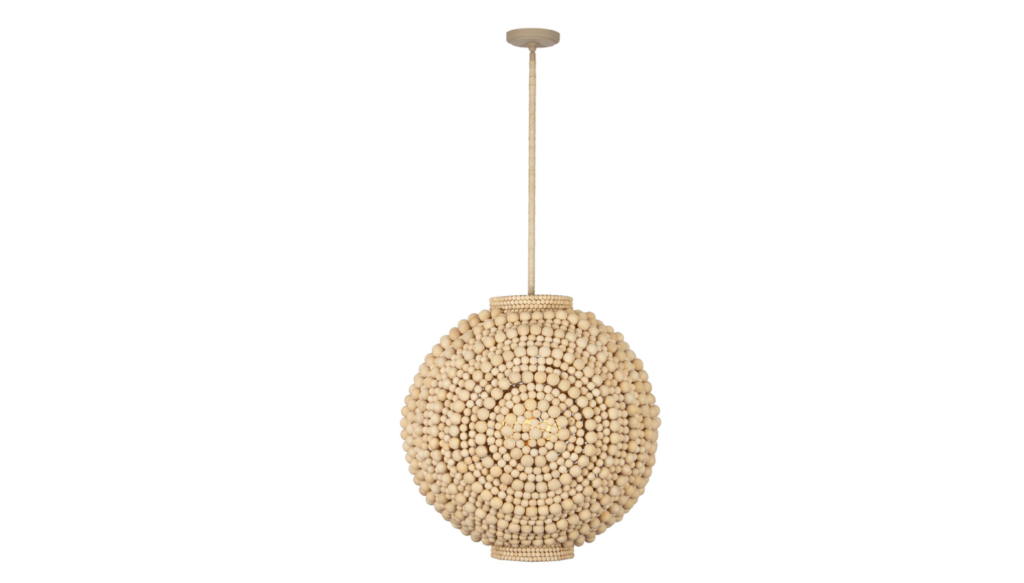
This round pendant is part of Kalco’s Coaxial collection, which combines natural materials and modern design. Wooden beads and abaca rope lend an organic feel, and the arrangement of the beads allows light to pass through, creating warm, intriguing patterns. (That’s another principle of neuroaesthetics: Humans find reassurance in pattern.)
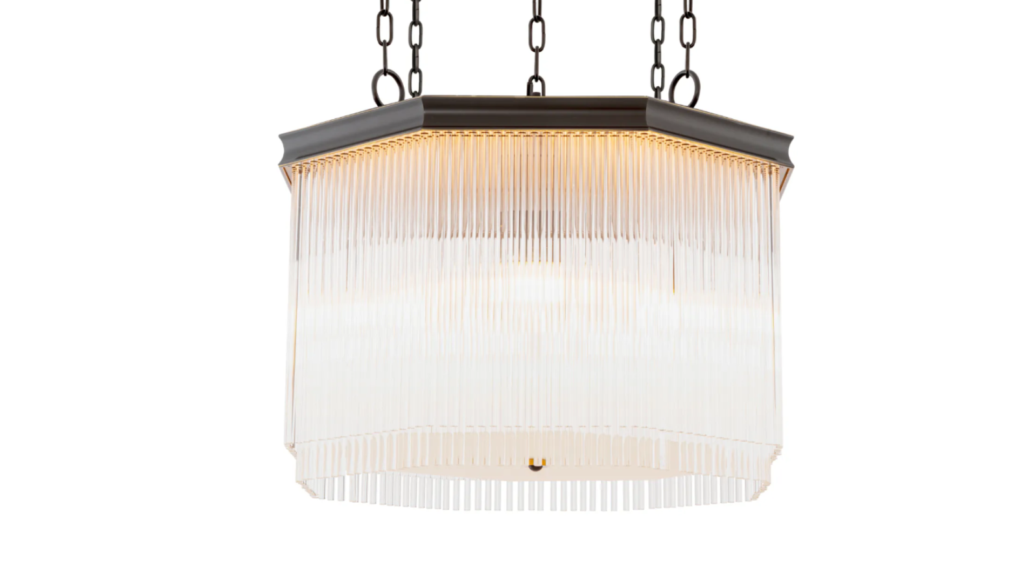
Eichholtz recently launched a lighting line with Corey Damen Jenkins, its first collaboration with an interior designer. The company describes the collection as blending classic and historical elements, including Egyptian, Babylonian, neoclassical, Viennese Secession and Art Deco influences. But in some pieces, we see biophilic influences, as well. Case in point: the Estela chandelier. The dark bronze octagonal frame and substantial chains may evoke the geometric rigor of the 1930s, but to us, the hundreds of slender glass rods, catching and reflecting light, mimic the mesmerizing cadence of raindrops streaming down windowpanes. Estela is also available as a wall lamp.
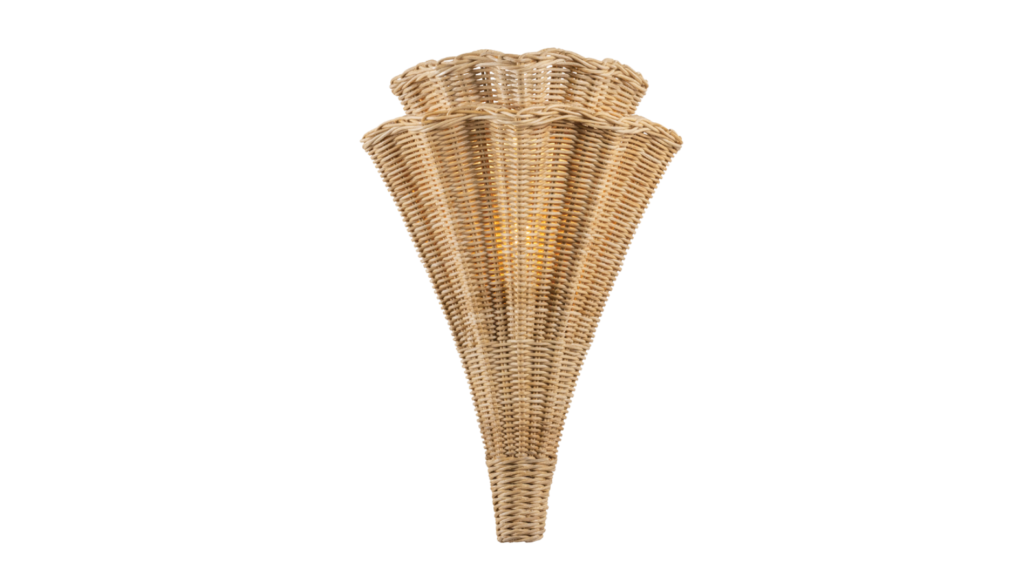
In the Arvern sconce from Hudson Valley Lighting Group, two hand-woven wicker shades with scalloped edges are layered to create a seashell silhouette. “As light seeps through the tapered forms, it brings out the natural texture and tonal variations of the rattan,” the company notes.
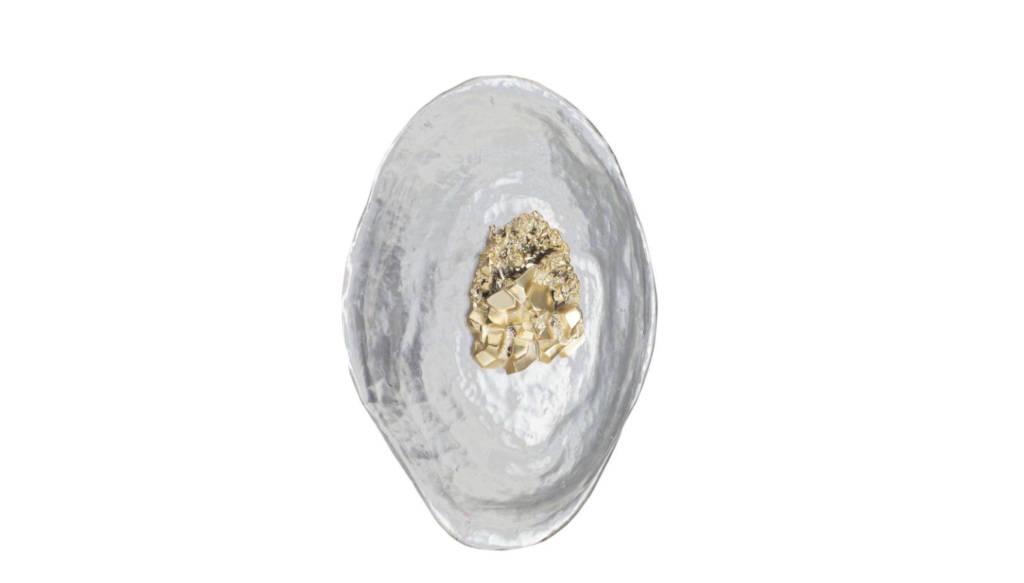
Combining organic forms and echoing sea life, the Nome sconce from Arteriors was inspired by oyster shells. The sconce is cast of rippled glass and adorned with silver leaf. The center “pearl” is a pale brass resin.
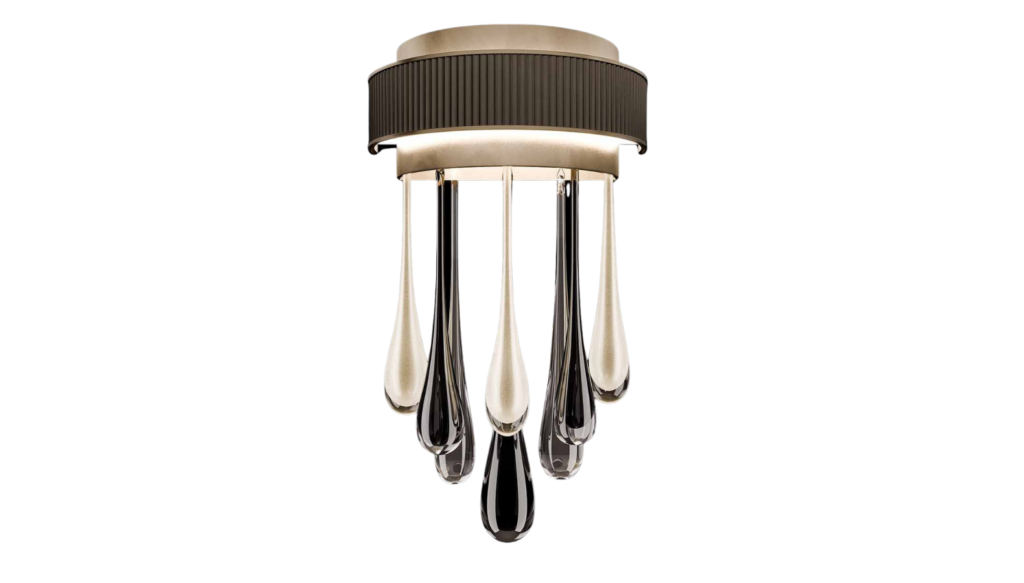
A more literal interpretation of water, Fine Art Handcrafted Lighting’s Rain LED sconce is made with blown glass “rain” drops the company describes as “infused with swirling mist and illuminated from within.” The fixture is available with Silver, Gold or Copper drops, paired with clear and black droplets.
Related articles
