While the focus at market is on product introductions and trend directions, it’s also an…
Read More →
While the focus at market is on product introductions and trend directions, it’s also an…
Read More →
The domestic manufacturer debuted the initial lighting launch with interior designer Christopher Todd during High…
Read More →
Interior and product designer Michael Wolk reconnects with Fine Art Handcrafted Lighting for Lomond, a…
Read More →
The change, announced during the week of High Point Market, is part of a leadership…
Read More →Susan Irie sells “lighting you can feel,” which means she focuses on the effects of good, functional lighting in a space as much as the aesthetics.
Kilohana Lighting used to display lighting like most other showrooms — with many fixtures hanging from the ceiling, covering the walls, and on displays. However, over the past decade or so, showroom owner Susan Irie has turned the typical showroom ethos on its head.
Located in Līhu’e, the second-largest town on the Hawaiian island of Kaua’i, one could assume that Kilohana Lighting would not have much competition due to its remoteness. However, it faces many of the same challenges as showrooms in the continental U.S. For example, there are seven Home Depots and four Lowe’s stores throughout Hawaii plus a handful of smaller electrical supply houses and national distributors such as Graybar, CED and Sonepar’s OneSource. And, of course, there’s the internet.
Just like their counterparts on the mainland, homeowners in Hawaii do not realize the significance of purchasing quality lighting – even for multimillion-dollar homes outfitted with ultra-luxury materials – and, as a result, will choose products that do not illuminate their spaces well. Sometimes the reason for that is budget, but more often than not, it’s because they don’t know what their lighting needs are and the difference good lighting can made.
Irie’s mission is to save homeowners and contractors from unwittingly making those mistakes by educating them.
How it started
Irie came to Hawaii in 1992 on her honeymoon with her then-husband, an electrical contractor. The day after they arrived, a Category 4 hurricane (Iniki) devastated the island of Kaua’i, where they were vacationing.
“In an effort to pitch in and help, we became immediately involved with the community. Having just married with no real roots established, we decided to start our planned electrical contracting business on Kaua’i,” Irie recounted. After experiencing the difficulty in sourcing ceiling fans and lighting, she eventually established a business as a distributor. That endeavor became Kilohana Lighting.
Learning the electrical business from her husband, coupled with her own education in economics and finance, was a skillset that made Irie’s perspective unique. In an interview with the Midweek Kaua’i newspaper back in 2016, Irie described her business then as “a lighting showroom, a lighting service center, a lighting design center, and a lighting educator.” In that regard, her mindset has not changed — but her showroom’s aesthetic has.
Irie’s passion for lighting and the science behind it is what drives her work. The typical lighting lab is usually one small room with recessed on the ceiling — and not all lighting showrooms even have a lighting lab, she pointed out.
“To me, that’s not really what a lighting lab should be,” she said. “As I was getting deeper into my lighting education, I realized that I’d have to spend hours teaching people our lingo – such as Kelvin temperature, ambient lighting and indirect – all of these general technical terms we need to use in order to discuss a customer’s space and the ways we can illuminate it, not to mention the concept of painting with light. And unless you study lighting, you just don’t know. It’s not a normal conversation that people have. There’s nothing intuitive about it unless you are one of those five percent of people who happen to be very sensitive to light and understand direction, reflection, glare, and those types of things.”
A light bulb moment
Irie came to realize that she had “overbuilt” her showroom 30 years ago, especially considering how people are shopping for lighting today. “The showroom was big, and it was taking all of my energy and time to keep it merchandised,” she explained. “I’m on an outer island; I am not in O’ahu [the main island]. I don’t have the kind of foot traffic that would make my time and energy worth it. I could have half a million dollars in fixtures on my ceiling, and it wouldn’t matter because nobody ever wants to buy what is on display. And, more importantly, when people are shopping online – and they all do – there are unlimited choices on the internet. With the sheer number of products on a website – and most of those images just show a product by itself and not the environment it is for – there is no way to shop successfully for architectural-type lighting unless you are a lighting designer. I have to engender enough trust with customers to be able to understand the price point they’re at, and their design sensitivities, so that I can marry their needs with their budget and find product that can deliver.”
Instead of customers coming in to look at fixtures or ceiling fans to buy, their conversations at Kilohana Lighting tended to be more about solving a lighting challenge in a residential or commercial space. That realization led to the change in how Irie re-imagined her showroom.
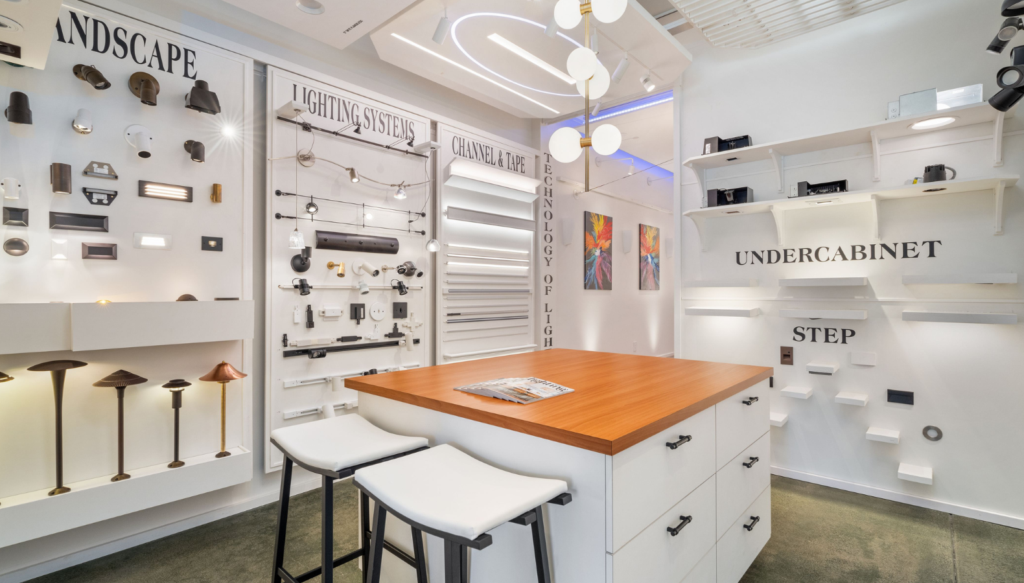
“I started thinking, ‘Ok, things [in our part of the industry] are very much going linear strip – which we’re really good at – and maybe just 10 percent of our business is in decorative lighting. We essentially have a high-end lighting specification business with a fan shop,’” Irie recounted. “We are specifying a lot of architectural lighting and we’re still doing a lot of track because we also have commercial clients who own shopping centers and they continuously make tenant improvements. So these cute little stores come into these shopping centers and when I look at their spaces, I realize that the only way for us to get the lighting effect they want is through a track system. Once we track their ceiling, we can hang lights, have track heads, or suspend some indirect lighting.”
To make the clients’ decision process easier and more collaborative, Irie decided to set aside 2,000 square feet of her showroom space to create demonstration rooms for showcasing various lighting effects and techniques. Her mission is “lighting you can feel” — and by that she means selecting lighting that evokes a human response, whether it is a warm, romantic feeling for a restaurant, a cozy atmosphere in a residential home, or an upbeat shopping vibe for a retail boutique.
“The reality is that nobody was coming into our showroom to look at products,” Irie said. “They’re talking to us [about solutions] and when it comes to the decorative pieces, we’re sending them to our website to use as a digital catalog where they can see all of the selections available.”
Another change involved how Kilohana Lighting displayed ceiling fans. In Hawaii, ceiling fans are a very popular category, but Irie noticed a lot of confusion in what consumers and commercial clients assumed about the category. Just as she believes lighting effects need to be experienced, Irie said the same is true for ceiling fans. It’s hard for consumers to tell from reading the number of CFMs (cubic feet per minute) on a box or an online description the amount of breeze they will feel from that particular ceiling fan.
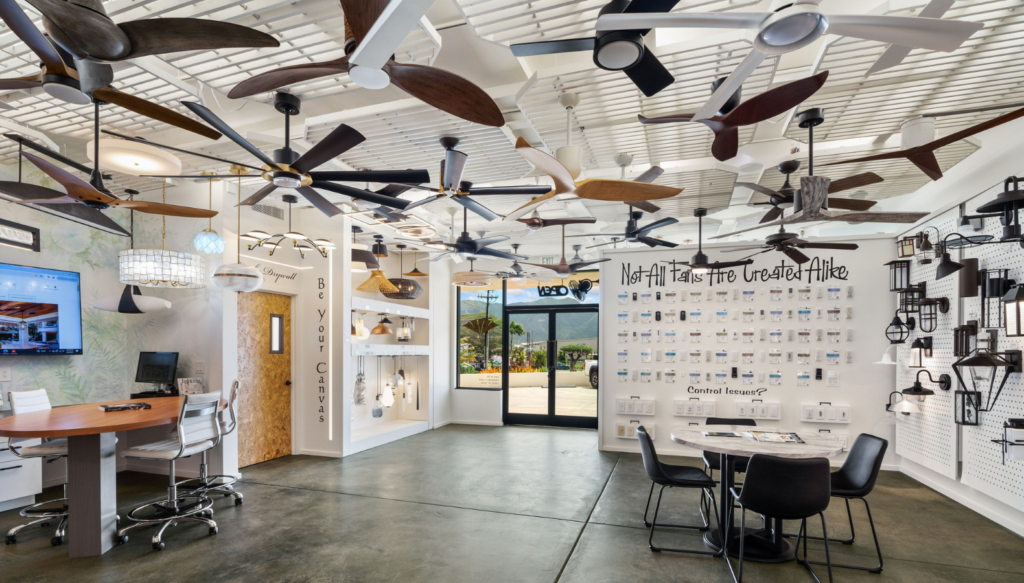
“That’s why we put every fan up on the ceiling,” she said, adding that finding a way to hang each fan so that the blades can spin without hitting an adjacent fan was a challenge.
All of the remote controls and blade options are mounted on an adjacent wall underneath a decorative sign that reads, “Not all fans are created alike.”
Irie’s top criteria for the ceiling fans was to show all of the information for each model plus how that data affects how that fan works. Each ceiling fan can be operated separately so clients can feel exactly how each specific fan feels when they are beneath it while it is operating. There is also a section on the wall marked, “Control Issues” that details the possible complications that may occur with various controls and how to troubleshoot them.
Portions of Kilohana Lighting resemble traditional showrooms, with sections of outdoor lighting and a display of pendants in various sizes to show scale. But it’s the larger areas for demonstrating lighting effects that are distinctive from other places where consumers, contractors, and specifiers can buy lighting in Hawaii.
For example, the words “Let drywall be your canvas” are painted on a wall featuring installations of mud-in recessed channel and other products. A different room showcases well lights, niche applications, downlights, uplights, cove, and track.
A semi-private conference area consists of a long surfboard table below a large, wall-mounted TV screen. “We sit with customers at the table, looking at their plans, specifications, or images, and they can look up and see everything we’re doing on the large screen,” she explained.
Ready for Impact
Even though Kilohana Lighting might not have the volume of walk-in traffic that a showroom on the mainland might have along a highway, Irie uses the expansive front windows to create a visceral message that her showroom is different from the competition.
“I change displays often and I make sure that people are able to look, see, and touch the lighting,” she said. “When they walk in, I want them to see something unusual right away. My thought process, when ordering for the showroom, is that I’m going to spend money on unique product, regardless of whether it may or may not sell. I want to show people the idea of what’s possible in lighting.”
Showcasing lighting products and lighting effects that stimulate design ideas or introduces an unfamiliar technology is part of the learning journey for customers visiting Kilohana Lighting.
“I believe this type of set up is the way the showrooms of the future should be,” Irie stated.
“Nobody in their 30s and 40s wants to come into a showroom to look at lighting. They’re doing everything online. They might want to close the deal by coming in and seeing you, but [shopping online] is where they’re at. We’re okay with being the reason to come into a showroom,” she said. And anyone who walks into Kilohana Lighting is pretty much guaranteed to come out with a deeper understanding of lighting.
In one of the demonstration areas, customers experience the room in color temperatures that run the gamut from 6000K down to 1800K. “We show people that this is very important because this is how your space will feel,” Irie noted. “I have 52 lighting elements in there and they’re all based around lighting ‘lessons.’ For example, I’ll show the typical four cans and a fan placement in the middle of the room’s ceiling. Then I’ll turn those off and flip another switch, and four cans are lit next to the walls in that same room — but the space feels very different.” Where the lighting is placed makes all the difference in how that space is perceived.
Even if the customer can only buy four basic recessed cans, Irie’s mission is to show them that putting those four cans “in a more appropriate place” on the ceiling rather than where the builder or contractor might automatically have them can make all the difference in the functional and emotional enjoyment of that room.
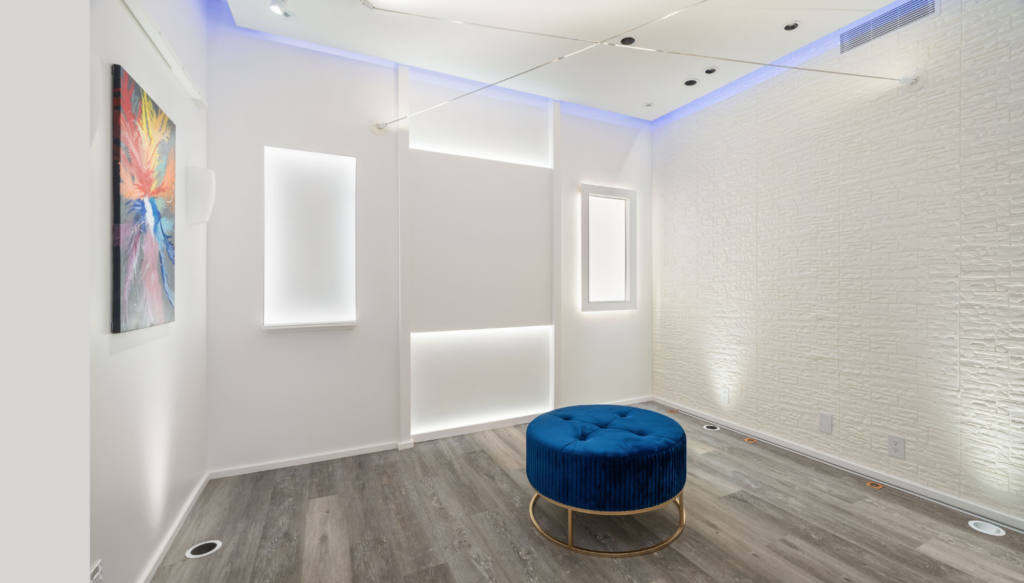
Irie is passionate about teaching customers “the logic and physics of lighting” in ways they can understand by seeing it for themselves. “I show how important it is that we use the reflective surfaces of their space to avoid glare. I show them how to backlight, how we silhouette and do handrails, valances, and step lighting. I’m showing them the tools of the trade,” she remarked.
For undercabinet installations, the cabinets lift up to show what normally would not be seen by the end-user. “We show people how it will be installed and how it’s wired to make it simple to understand,” she explained.
“These areas allow you to really sell lighting,” she said. “I also display product from a variety of manufacturers so the customers can touch and feel each to get a sense of what they can expect from each brand. There are differences in quality levels, but when they look at pictures online, they might not be able to understand that like they can in person. They might be at a certain price point, but they still need to know a bit more about what they are buying.”
Kilohana Lighting also has several warehouses throughout Hawaii in order to best service its customers. Its brand new website, which is still under development, is being custom-built to show only products available to Hawaii since Irie knows first-hand the frustration of selecting a product online – in many categories, not just lighting – only to discover after it is placed in the digital “shopping cart” that it is not able to be shipped to Hawaii. Irie’s priority is to eliminate that frustration.
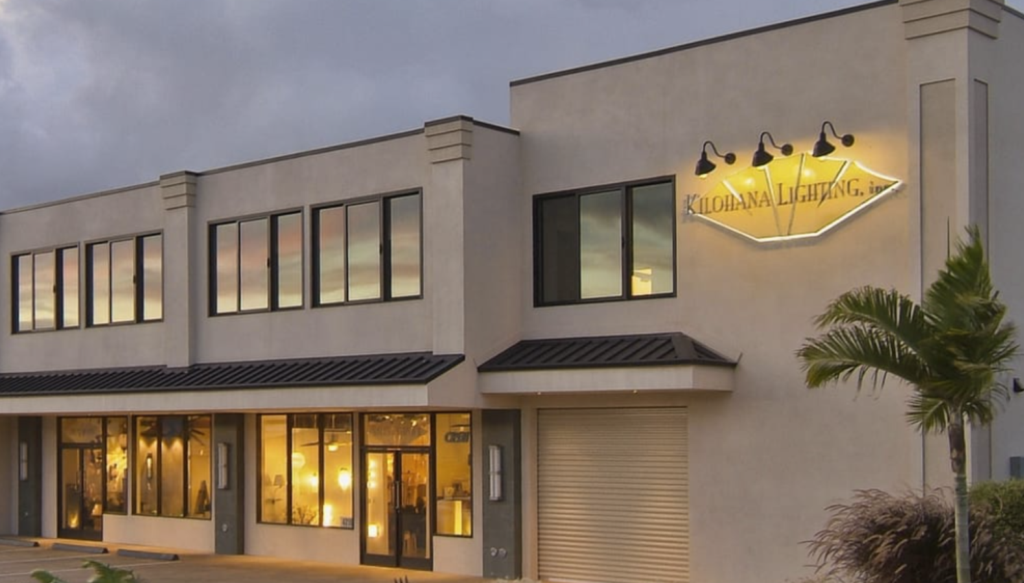
Ultimately, Kilohana Lighting’s super power lies with its staff’s expertise. “Customers can buy a beautiful fixture for a value-oriented price, but they need to know that they will be a bit limited in the quality and how it is put together,” Irie explained. “Conversely, just because a fixture they see online might cost one thousand dollars doesn’t mean it’s going to last in Hawaii’s corrosive environment. We have to understand and manage the expectations of our customers. We don’t make their buying decisions for them — we just share all of the information that they should have when deciding on a fixture for their budget, their project, and their aspirations. I think this is the way showrooms should work now.”


This is a wonderful explanation of where the residential lighting industry must go. Thanks for the story Linda and thanks to Susan for the insight!
Thank you, Jeff. Your opinion is always greatly appreciated.
Jeff, coming from you, this means everything. The showroom model had to evolve — our customers are too smart and too busy to come in and stare at fixtures on a ceiling. What they need is to understand what light does to a space and how it makes them feel. That’s the conversation worth having, and I believe it’s the one that saves our industry.