While the focus at market is on product introductions and trend directions, it’s also an…
Read More →
While the focus at market is on product introductions and trend directions, it’s also an…
Read More →
The domestic manufacturer debuted the initial lighting launch with interior designer Christopher Todd during High…
Read More →
Interior and product designer Michael Wolk reconnects with Fine Art Handcrafted Lighting for Lomond, a…
Read More →
The change, announced during the week of High Point Market, is part of a leadership…
Read More →This experienced industrial designer believes creativity must be rooted in the needs of customers and the demands of cost ratios. He also knows that “crazy” ideas ignite a company and keep it growing.
By Julie A. Palm
As an experienced industrial designer of consumer goods, David Patton knows creativity must be informed by customer needs, manufacturing feasibility and cost ratios. But he also knows that to move a company forward, you’ve got to explore the riskier ideas, too.
“I like to keep 10% to 20% of what I always like to call ‘crazy.’ We don’t really need a reason to do this, but we’re just going to try it and see what happens,” says Patton, who joined Fort Worth, Texas-based lighting producer Quorum about 2 ½ years ago.
Quorum’s Ondine is an example of a collection that arose from the crazy. Named after the mythical water nymph, the 10-inch sconce features lotus-inspired elements and builds on the company’s earlier Del Rey sconce. Both were designed to be used alone or to be grouped together for dramatic wall displays.
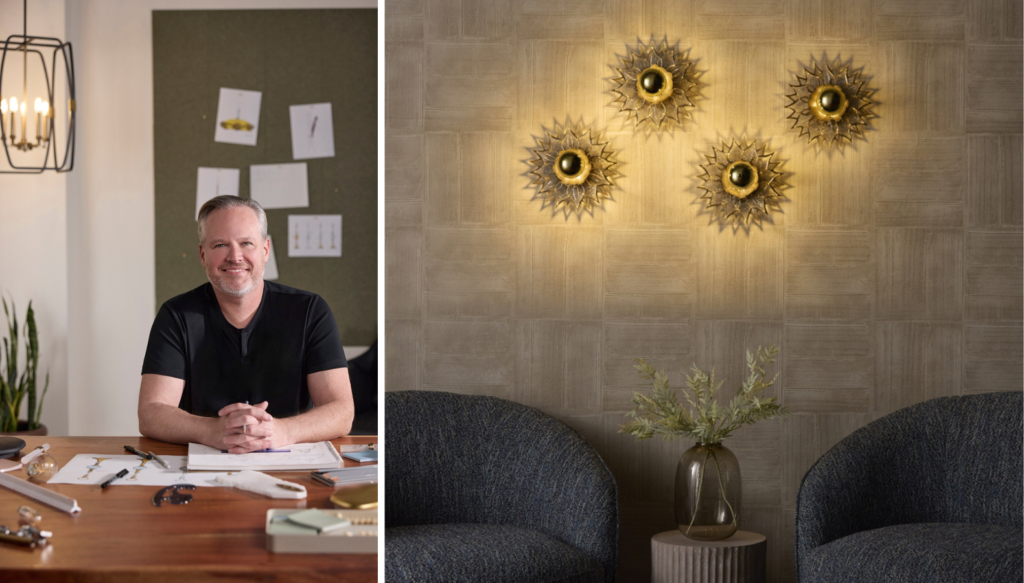
“I’m really excited and proud of this. … I haven’t bragged about (company president) Jose (Lopez) yet, but he hired me and he’s been an excellent partner. He’s given me the latitude to just do what I do and try things,” Patton says. “And so, we created what I’m calling a decorative wall mount. It’s not a typical sconce. It’s more like if you took a ceiling mount and put it on the wall. It has that kind of architecture.”
“I wanted to take the light experience further,” Patton continues. “What if we played with atmospherics? … What if we bounce the light and let the shadow and the way that it filters through the water glass be part of the overall visual experience of this piece? That was the impetus for the Del Rey. And then I just wanted to take it a little bit further with Ondine.”
“This is worth it”
Patton is best known for co-inventing and patenting the first “desktop converter” and launching standing desk company Varidesk. People with back pain and other health problems found the standing desk “life changing” — and let the company know, he says.
“I keep those letters in my desk. If I’m feeling down,” he says, “I break those out and I remember, ‘This is worth it.’”
He brings a similar sense of mission to lighting design. “People who’ve been in the lighting business for a long time – and it’s not their fault – can take the lighting mission for granted,” Patton says. “The light fixture solves the consumer issue as long as it turns on and off because ideally you want to light a room. That’s the primary need for a light fixture. But there are so many other ways that a fixture transforms a mood — by the way it looks, the way it transmits light, the temperature of the light. There are so many things that affect human psychology that I have always found (lighting) fascinating.”
“…It’s easy to phone it in and to say, ‘A fixture is a fixture.’ But that’s where I find joy and the creativity. It’s one of the reasons I wanted to come back to come back to lighting — because I think there’s so much still yet to be done,” he continues, referencing an earlier stint at Craftmade.
Patton describes the Quorum as occupying “a unique middle space” in the lighting market.
“Our goal is to pair sophisticated product design with attainability. … We want to have sharper pricing. We also want to couple that with deeply relationship-oriented service, which is something that Quorum was known for long before I came here. And I love that about Quorum because I’m a relationships person, too,” Patton says. “We’re able to do that first part by leveraging really smart industrial design so that we can maintain the quality that customers expect, while we eliminate lazy cost buckets. We’re not doing that through diminishing quality.”
Instead, Patton says, the company looks for ways to, for example, reduce packaging costs or make smart material swaps, such as fabricating a piece rather than die casting.
“There are all these touchpoints along the way that really don’t have anything to do with how people think of the product but that ultimately make a huge difference when we get to the final cost of an item,” he says.
Customer-sparked creativity
The design process at Quorum starts with business strategy, including consumer research.
“One of the biggest lessons that I’ve learned in my entire career that I always go back to — and, I think, I ultimately need to have a sign on my wall that says, ‘Listen to your customers.’ That’s the best possible thing we can do, and I’m talking about everyone, from the rep to the dealer — anyone who is giving you feedback.”
As they gather and process data, the Quorum design team, which includes Patton and three other designers, evaluates the company’s existing lines. “We look for holes and we look for ways that we can make our line more efficient and more attractive to the different channels that we’re operating in. And we do all of that before we ever put a single pencil to paper because we need to know what we’re going after.”
Then come the “sprints,” as the design team focuses on a specific product line (such as outdoor lighting) or market channel (such as lighting showrooms), filling in holes in the line or meeting new customer needs.
“We’ll do a lot of sketch work,” Patton says. For him, that often starts with pencil and paper or his tablet. “… And maybe take a few days where we’re just in studio doing that, getting stuff on the walls. Then we’ll start to break that down. How are these concepts addressing the needs? And then we’ll eliminate things that really don’t (and) perhaps keep things that don’t, but that fall into that crazy category: There’s no business justification for it, but we want to keep thinking about it.”
From there, sketches go into design software for modeling and mechanical drawings. Then the team prepares a design brief that goes to factories. “It’s a complete design intent document of what we’re looking for,” Patton explains. As samples are made and production starts for those products, the design team begins a sprint into another category and channel.
As director of design, Patton’s calendar can fill up quickly with strategy meetings and other responsibilities. Still, it’s important to him to continue to design, so he blocks out time on his calendar – ideally, four hours a few times a week – specifically for creative work.
“But my team has probably 80% to 90% of their time open to explore,” Patton adds.
Inspiration can come from almost anywhere, but Patton often finds himself looking backward to move the company’s designs forward.
“I think the most interesting sources of inspiration for me, believe it or not, are in history,” including previous design movements and styles, he says.
“I’ve got a piece coming out soon that I can’t really talk about, but it’s based on a very specific need that people without a lot of money had for light fixtures. I think I’ve created a modern multi-use fixture that is directly inspired from historical pieces. It’s never really been done in the market before — not in modern times.”
Patton also loves making trips to Maison & Objet in Paris and visits to the city’s famed antiques market. Closer to home, he likes to browse the Dallas Design District.
While it’s easy for a designer to get caught up in creating buzz-worthy lighting, Patton and Quorum’s design team focus on turning the creative spark into revenue.
“Our process really helps us slow down, evaluate and make sure that (something) is really going to serve the business. Because as much lighting as there is in everybody’s line, there’s only so much room,” Patton says. “You’ve got to make sure you have the best things in there that serve your customers. It’s a long way of saying that we put some guardrails up to save us from our own impulses.”
The results
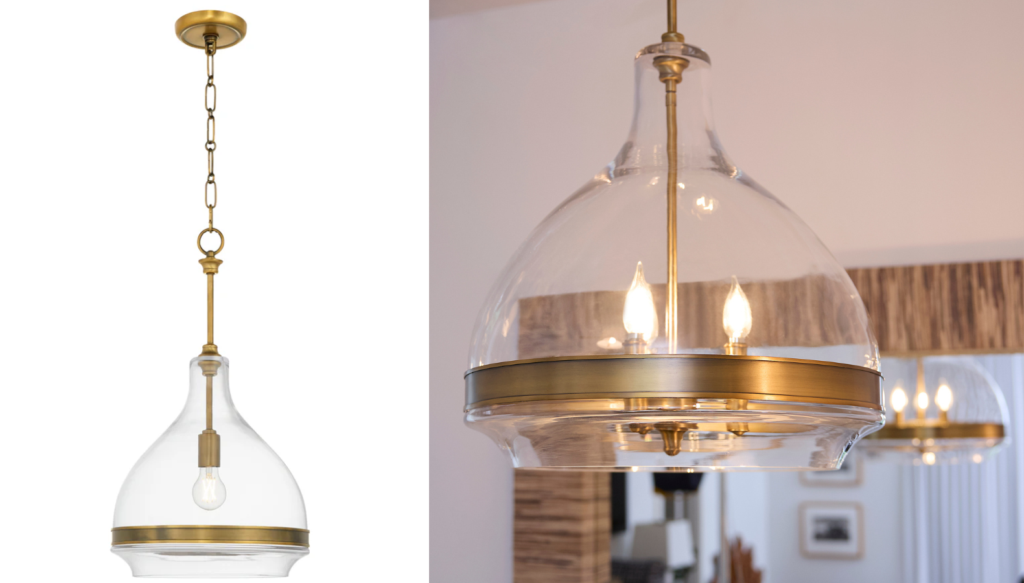
A couple of recent introductions illustrate Quorum’s design process. Tilbrook, a two-pendant line, was an effort “to show more decorative than we’ve shown in the past” and to create “some solid, tasteful basics,” Patton says. The pendants feature gold-banded clear glass bell shades.
“Tilbrook is one of those classic, Colonial American designs with a modern cleanliness to it,” he says. “So, it’s very familiar, but it’s also different and feels fresh.”
At the High Point Market in April, the company expanded its Favo LED line, part of its Oxygen brand. The group, featuring opal glass staggered with brushed brass, now includes a sconce and multiport fixture, in addition to the two original pendants.
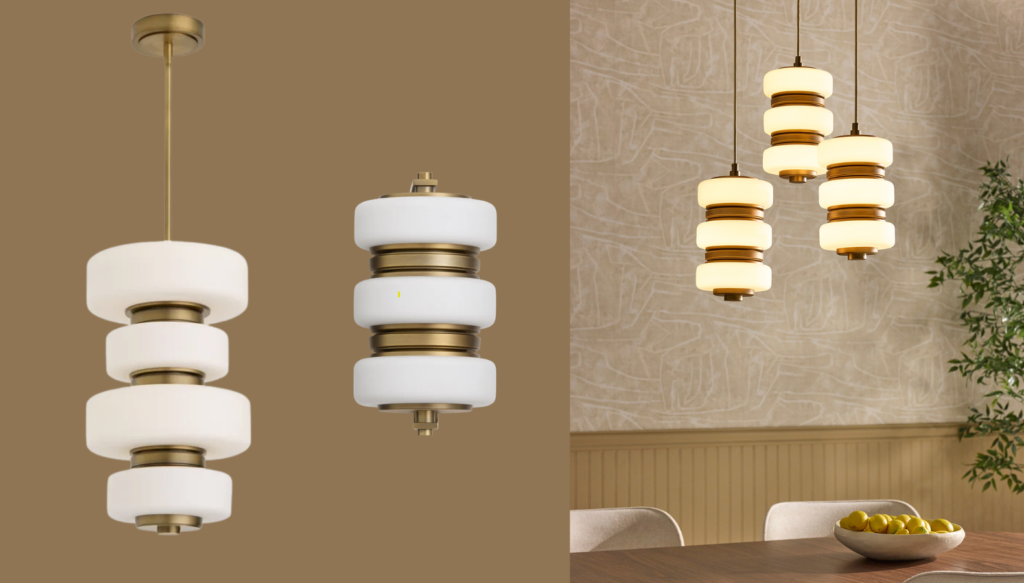
“It was inspired by classical Japanese architecture. Think shoji screens and (Toyo) Ito architecture,” Patton says. “It’s been fun to take that inspirational concept and translate it in a modern way.”
What’s ahead from Quorum? Patton says customers can expect to see more modern versions of crystal chandeliers, more white opal glass (based on customer requests for less clear glass) and re-interpretations of traditional designs for cleaner looks.
“I think we’re seeing less ultra-clean designs that lack personality,” he says, discussing general lighting design trends. “I think people are wanting more personality to come back, which is why they’re pushing for traditional to return. And I think it’s why they’re fed up with coffee can ceiling fan designs.”
“I was personally very shocked to come back to the industry and see how many coffee cans that there were,” Patton adds. “… We’re already experimenting. We’re going to have a new flight of fans where we’ve basically taken the coffee can and we’ve added to that, like with decorative turnings. We’re adding leather to it and other things that are going to make it richer.”
Quorum has been around for 45 years, and Patton and his team are committed to advancing the company in terms of great design rooted in customer needs.
“I want people to know that Quorum is different,” Patton says. “… We’re committed to growing and being able to service a broader spectrum of customers than maybe we did in the past. … Come by. Look at the showroom. See for yourself. I’m happy – the whole team is happy – to walk you through and share what our vision for the future is.”
Related articles