While the focus at market is on product introductions and trend directions, it’s also an…
Read More →
While the focus at market is on product introductions and trend directions, it’s also an…
Read More →
The domestic manufacturer debuted the initial lighting launch with interior designer Christopher Todd during High…
Read More →
Interior and product designer Michael Wolk reconnects with Fine Art Handcrafted Lighting for Lomond, a…
Read More →
The change, announced during the week of High Point Market, is part of a leadership…
Read More →As the single-family new construction market stagnated in 2025 due to rising interest rates, lighting manufacturers and showrooms found solace in the multifamily housing sector. This year, that opportunity is predicted to change.
As manufacturers, showrooms, and reps informed me during the Lightovation shows in 2024 and 2025, the multifamily market is where they were seeing a lot of growth versus new single-family homes, which had been the core business for decades.
AFX officially debuted its ceiling fan line during January Lightovation to augment its wide variety of product categories for the multifamily market. Similarly, Bulbrite expanded its product line to include a new line of disc lights that would appeal to the multifamily sector as well as single-family builders.
As a Q2 2025 report from Cushman & Wakefield noted, “multifamily demand remains robust. More than 116,000 units were absorbed, marking one of the strongest quarters on record dating back to 2000. Through the first half of the year, the multifamily market has absorbed 216,000 units, on par with [2024’s] near-record setting pace.”
The reason for that uptick in multifamily had everything to do with job creation in the Sun Belt and Mountain regions – as many corporations relocated for greater tax savings or took advantage of financial incentives to build data centers, tech hubs, and specialized healthcare facilities – and the migration of an older population reaching retirement years and looking for a more affordable cost of living.
Cities and areas cited most often as leading growth were Dallas and Austin, Texas; Phoenix; Raleigh and Charlotte, N.C.; Nashville; Atlanta; Denver; Seattle; San Diego; Huntsville, Ala.; and Indianapolis.
Over the past two years, supply has been gradually catching up with demand. As recently as last month’s Lightovation show, multifamily projects were still outpacing single-home construction according to industry members I spoke with, but it was beginning to show signs of leveling off. The Cushman & Wakefield report had predicted that multifamily would slow in the second half of 2025 — and that appears to have been true.
At last week’s International Builders’ Show in Orlando, economists addressing the National Association of Home Builders (NAHB) also expressed some caution. “The rental market has slowed following a pandemic-era boom due to demographic changes, softer labor market and rising vacancies and is moving towards a more constrained development environment,” they said.
According to NAHB stats, multifamily property sales rebounded in 2025, increasing 15% as fresh supply came on to the market after a three-year slump.
“The regional sales shifts were notable, as we saw particularly strong growth in Midwest and California metros,” said Molly Boesel, senior principal economist at Cotality, who spoke at the Builders’ Show. “Meanwhile, some Sun Belt markets that surged in 2024 posted declines in 2025.”
A post-show statement from the NAHB indicated that home affordability challenges has caused many renters to stay in the rental market. High supply helped push multifamily rents down 1% year-over-year while single-family rent growth slowed.
“The national multifamily vacancy rate ran up to a record high 7.3% in December,” said Boesel. “We’re past the peak of a multifamily construction surge, but a healthy supply of new units is still hitting the market and colliding with sluggish demand, causing vacancies to continue trending up.”
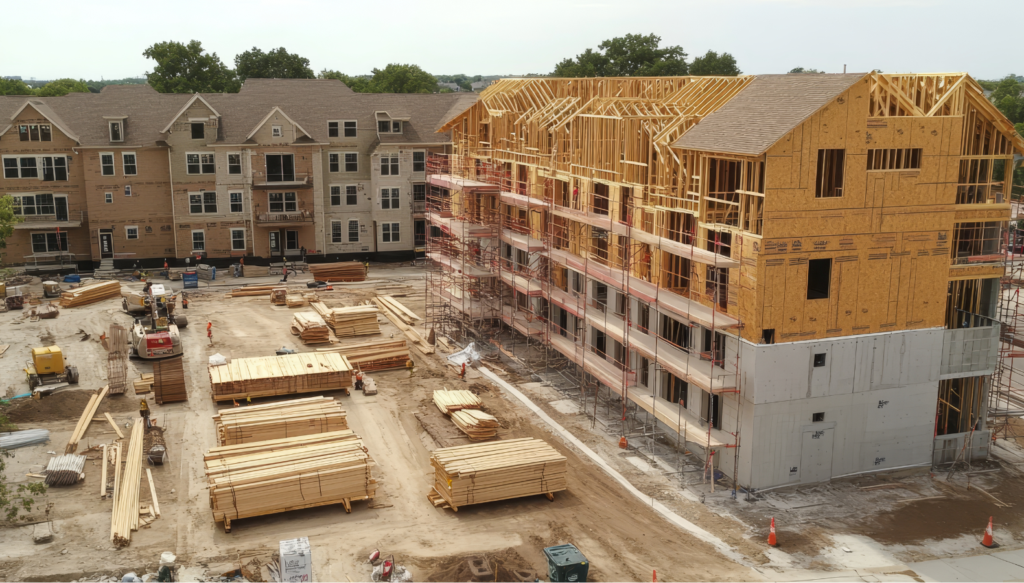
According to the NAHB, multifamily property values declined 4% in 2025 compared to 2024 and are roughly 28% below the 2022 high. However, values are now 8% above 2019 values.
The multifamily market is still experiencing a rise in delinquency rates but remain well below office building delinquencies. “Delinquency rates are rising due to higher interest rates, changes in property market fundamentals and uncertainty about property valuation,” Boesel noted.
Looking ahead, the NAHB expects multifamily starts to fall 5% in 2026 to an annual pace of 392,000 units and decline an additional 6% in 2027 to a 367,000 rate, leveling off near pre-pandemic levels.
“The multifamily market has slowed due to tighter financing and elevated construction costs and is moving towards a more constrained development environment,” explained Danushka Nanayakkara-Skillington, NAHB’s assistant vice president for forecasting and analysis. “However, despite the pullback in starts, multifamily completions reached a 38-year high in 2024 with 608,000 units as projects initiated during the boom years were delivered to market.”
The composition of multifamily production has shifted toward larger properties as 50+ unit buildings accounted for 54% of completions in 2024, the highest share in decades.
Nanayakkara-Skillington pointed out that the “missing middle” construction sector – which includes development of medium-density housing, such as townhouses, duplexes and other small multifamily properties – remains limited. She remarked that the multifamily segment of the missing middle (apartments in 2- to 4-unit properties) has generally disappointed since the Great Recession, totaling just 4,000 starts in third quarter of 2025, representing only 3% of multifamily production.
All regions saw increases in multifamily completions in 2024, with the South dominating total volume. Here is the breakdown of growth rates:
• South: +37%
• West: +36%
• Midwest: +31%
• Northeast: +23%
There was some good news. According to the most recent NAHB Multifamily Market Survey (MMS), confidence in the market for new multifamily housing shows production sentiment improving, while occupancy conditions remain comparatively strong despite elevated vacancies nationally.
“In addition to tight lending conditions and high construction costs, the local regulatory environment continues to be a major headwind to faster growth,” said Nanayakkara-Skillington.
Meanwhile, the Multifamily Occupancy Index (MOI) had a reading of 74, indicating existing apartment owners are positive about occupancy.
Another positive: the industry will most likely be supported by a potential influx of young adults as they enter the housing market.