While the focus at market is on product introductions and trend directions, it’s also an…
Read More →
While the focus at market is on product introductions and trend directions, it’s also an…
Read More →
The domestic manufacturer debuted the initial lighting launch with interior designer Christopher Todd during High…
Read More →
Interior and product designer Michael Wolk reconnects with Fine Art Handcrafted Lighting for Lomond, a…
Read More →
The change, announced during the week of High Point Market, is part of a leadership…
Read More →Style Editor Julie A. Palm talks with Hubbardton Forge’s Maria Mullen about how the company’s commitment to beautiful lighting and environmental responsibility are linked.
By Julie A. Palm
At lighting producer Hubbardton Forge, style and sustainability are intertwined.
It’s not about one team producing beautiful lighting and another team looking for nitty-gritty ways to reduce waste during production.
“It goes back to our DNA. It’s very automatic for everyone here to think about what’s best in terms of design and the environment” — and to work together to achieve those goals, says company CEO Maria Mullen. “Our designers absolutely do keep sustainability front and center.”
In January, Hubbardton Forge won the Green Award at the 36th Annual ARTS Awards in Dallas, also picking up the top prize in the Lighting Fixtures category. I wanted to talk more with the company about how it approaches sustainability — and how its efforts impact look and design of its products. We also talked about how lighting showrooms and designers can talk about sustainable lighting with consumers and clients in meaningful ways.
Part of a place
Mullen says Hubbardton Forge’s commitment to sustainability is rooted in the company’s location in rural Castleton, Vermont, near the Green Mountain National Forest.
“When you look out over the beauty that is in this state – the Green Mountains, the beautiful lakes – you don’t really need a corporate handbook to tell you to protect the environment,” Mullen says. “To do anything different would be so completely counterintuitive.”
“My design team, maybe in particular, they are very outdoorsy,” she continues. “They love to be out in nature, and they take a lot of inspiration from nature. I think that bleeds into what they’re doing here in every way.”
One of the clearest ways the company’s design and sustainability goals have merged is in Hubbardton Forge’s Coral collection, in which each coral “reef” is created by artisans who weld small, individual cast coral-like pieces of aluminum to create flowing organic arrays.
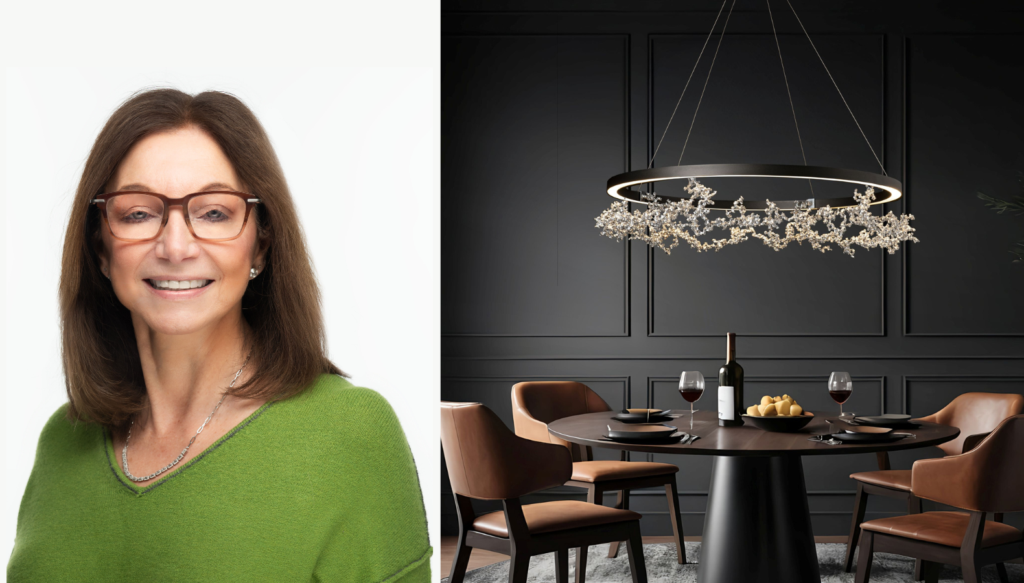
“The Coral is simple in its beauty but complex in its creation,” says designer Jason Hancock on the company’s website. But the delicate, stunning Coral fixtures have their origins in something humbler: the desire to recycle the company’s house-made tooling.
At the end of its life, the aluminum tooling is melted down and turned into Coral pieces. (Mullen notes that the recycled tooling is now supplemented with other aluminum because of the popularity of the collection.)
“Coral was the result of what we call ‘skunk works’ here, which is basically people playing in the manufacturing process to see what we can do, what we can accomplish and what the next frontier is,” Mullen says.
“We look at everything,” she adds. “We’re looking at metal shavings and how do we incorporate that into something. Can we take that to the glassmaker and have him put that into the glass? We hate waste here and we try to find ways to reuse things when possible — as long as they are also beautiful.”
Other sustainable Hubbardton Forge practices include:
• Making products to order: The company makes each piece one at a time by hand. Not overproducing reduces the number of products that could end up in landfills if not sold, Mullen notes. This ethos extends to designers working closely with manufacturing teams to reduce even the number of samples created.
• Zero-waste powder-coating: “We operate one of the most advanced powder-coating systems in the industry, and this system allows us to reclaim and reuse nearly all of our overspray,” Mullen says. “Our process is a very strictly low VOC to protect both our air and our artisans here.” The company also operates a closed-loop water system for cleaning its steel and aluminum before powder coating.
• Small production footprint: All the company’s approximately 200 employees – including engineers, designers, welders, forgers and administrative teams – work in the same facility. It promotes collaboration and reduces the company’s carbon footprint. “We’re not taking flights 8,000 or 9,000 miles away to look at products. And we’re not filling containers and bringing them over,” Mullen says. “We always try to source as close to home as possible. We don’t always succeed because not everything is available in Vermont or even in New England, but we start here and work our way out.”
• Embracing LEDs: Every piece in the Hubbardton Forge line is either integrated LED (in partnership with LEDdynamics in Randolph, Vermont) or compatible with LED bulbs. The company also sells replacement LED modules for integrated fixtures so that the entire fixture doesn’t have to be replaced when the LED module fails. “This is a big selling point for designers, showrooms and consumers because you don’t have to take the piece down to replace it,” Mullen says, adding that Hubbardton Forge’s tech support team will make Zoom or Facetime calls to help walk electricians or others through the replacement process.
“We want people to keep our products as heirlooms,” Mullen says. “You can’t do that if you can’t guarantee that they can replace the LED module.”
This is another place where sustainability and style intersect. The advent of LEDs has allowed Hubbardton Forge’s designers “to play with form in ways that was not possible in the past,” Mullen says. “They can create really thin profiles and organic shapes, which our guys love, and they aren’t constrained by the old socket structure and the heat of that traditional socket. It gives them more freedom.”
The problem of packaging
Mullen is particularly passionate about reducing packaging and improving the sustainability of its packaging materials.
“I am personally a crazy recycler,” she admits. “I’ve worked in offices where they didn’t do recycling, and I’d bring it home. I’ve brought cans and bottles home from markets that didn’t recycle. I don’t know what it is about me, but I’ve always hated that kind of waste. I love the ethos of this company and we’re doing all of these things that are sustainable, but the one thing that sticks in my craw is packaging.”
But finding more sustainable packaging is a challenge for products that are fragile and often heavy. “And we don’t want our customers to have to a do a lot of assembly,” Mullen adds.
Her goal is to move away from foam-in-place packaging, in part by using an alternative from ExpandOS, made of ridged, folded cardboard triangles. ExpandOS works particularly well for smaller fixtures, including outdoor lighting and sconces.
“This is my personal Holy Grail — to get to 100% sustainable packaging,” Mullen says. “We’re getting better and better, but we’re not quite there yet.”
Talking to consumers
Except for when choosing LEDs, sustainability may not be as top of mind for consumers buying lighting as when they are shopping for other products. But Mullen thinks there are opportunities for lighting showrooms and designers to talk with customers and clients about sustainability.
“I think that they have a unique opportunity to tell a story of value because, to me, sustainability is often a proxy for quality. We encourage sellers to focus on the heritage aspect: Buy it once, keep it forever,” Mullen says. “That’s where that replaceable LED module comes in. You’re not going to have to take the fixture down and throw it away at any point. So, if we shift the conversation from disposable decor to more functional art, then the sustainability argument wins.”