Surprise! More than half of “mature singles” and “couples” said they prefer to rent —…
Read More →
The founder of Conceptual Lighting believes most people under light or over light their homes…
Read More →
Maxim Group and Kichler are the two lighting brands featured at the reimagined Design Hub…
Read More →
The new interface offers enhanced functionality and more intuitive navigation. Whitsett, N.C.-based furniture, lighting, wall…
Read More →Surprise! More than half of “mature singles” and “couples” said they prefer to rent — and this demographic is seeking quality.
It used to be that within roughly five years of graduating high school, young people were renting their first apartment. And approximately five or more years after that, they were actively making plans to buy a home.
All that has changed over the past several years with the housing pressures of supply and demand, stubborn inflation, rising interest rates and overall financial insecurity caused by fluctuating market conditions.
Nowadays, many 20-somethings are living at home instead of an apartment, and the median age of first-time home buyers is somewhere between 33 and 38 — with the National Association of REALTORS® (NAR) stating that the median age has reached an all-time high of 40 years, according to its 2025 Profile of Home Buyers and Sellers report.
Gen Z (people in their late 20s) is understandably budget-conscious, so any shopping for lighting and home décor is more focused on price and need. (Check out our exclusive Consumer Insights Now survey results on Gen Z buyers.)
With homebuying activity in a holding pattern, renting is a more attractive option for Millennials (who range in age from 30 to 45) who haven’t purchased a home and are waiting for better market conditions to do so. Specifically the relatively new niche of Build to Rent (BTR) communities popping up nationwide – especially in the Sunbelt – is fast-becoming a viable option.
BTR properties are not synonymous with condos or townhomes, which can be individually rented out by unit owners. While BTR communities can be vertical (similar to townhouses or row homes) or horizonal (detached homes), the appeal lies in offering all of the benefits of a traditional single-family home in regard to space and privacy without the financial burden of a down payment, paying a high interest rate or the labor and cost of maintenance.
According to Point2Homes, which specializes in helping consumers find homes for rent, these new Single Family Rental (SFR) BTR communities are growing in popularity and offer a range of square footage. “Traditional detached homes in markets like the Southeast offer larger footprints (up to 2,500 square feet) and attract families looking for suburban living, while luxury BTR homes in high-demand areas like California and Nevada offer premium space (2,000 to 3,000 square feet) and rents upward of $7,000 per month.”
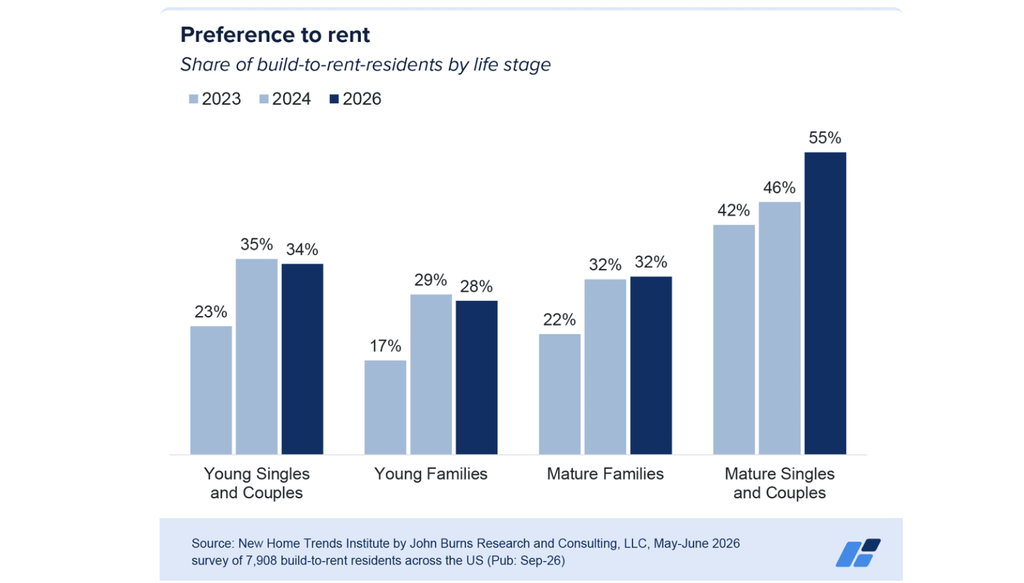
The BTR concept holds great appeal for Americans who have sold their existing home and are waiting for interest rates to fall before buying another. They consider it as an upscale alternative to downsizing to an apartment or condo while in between moves. For adults over 60, selling their home at a premium price and not having to sink that profit into buying a new home provides them with financial security to live comfortably in retirement without giving up the spaciousness of a single-family home. For them, renting a single-family home with a backyard costs far less in comparison.
For the aforementioned groups, renting is not viewed as the temporary solution it once was. According to research from the New Home Trends Institute presented by Mikaela Arroyo of John Burns Research and Consulting, LLC – which surveyed nearly 8,000 BTR residents across the U.S. in May and June – nearly 75% plan to stay three or more years. That number is up from 58% in 2024, while the percentage of those planning to leave within one to two years fell from 41% to 27%.
Additional key takeaways that Arroyo cited from the New Home Trends Institute survey are:
• Mature singles and couples are leading the trend, with 55% now preferring to rent, up from 46% in 2024. And 40% of those surveyed said cheaper rent alone wouldn’t be enough to make them leave.
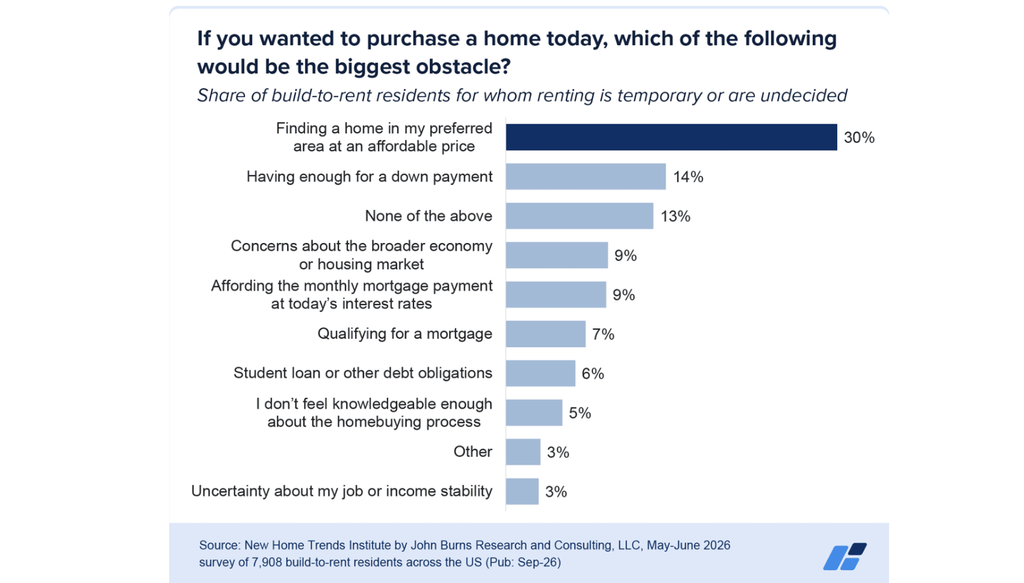
• Younger families rent for space and location they can’t yet buy: Their biggest hurdle isn’t the down payment — 30% said the real challenge is finding an affordable home in the area they want to live in.
• And while longer stays improve property investors’ revenue (with fewer turns, lower vacancy and lower leasing costs), it does increase the need for greater durability in materials.
Arroyo’s advice to home builders entering the BTR sector is to shift toward a long-term operator mindset when it comes to material choices and layout decisions for these homes. “Spec for five years of wear, not 18 months,” she noted. Selections for flooring, paint, hardware, storage, and areas of everyday use should reflect the possibility that the same resident may be living there for many years.
The bottom line for lighting players
Whether your lighting business is on the retail or manufacturing side, there are factors worth noting when it comes to the proliferation of BTR communities being built nationwide.
Outfitting these types of rentals is not the same – in aesthetics and budget – as a typical suburban apartment complex. For showrooms and manufacturers, developers of these properties are more willing to embrace packages in the “better” category (of good, better, best) for a more elevated ambiance throughout — meaning upgraded recessed lights and more decorative fixtures for the foyer, kitchen, bath, and outdoor. There is also an opportunity to incorporate accent lighting (i.e. cove, toe kick, interiors of drawers and cabinets as well as landscape lighting) into these packages to enhance the tenants’ enjoyment of the homes in these BTR communities.
In many cases, these BTR tenants intend to stay in these homes on a long-term basis and are more willing to purchase moderate to higher-end lamps, torchieres, accent furniture and wall art that don’t look like placeholders until they move into their “real” home. For many older BTR tenants who do not want the expense of homeownership and have amassed wealth, they want nice things in a better quality that will last because they intend to enjoy that living space for years.
Showrooms, keep an eye on BTR property development in your region and invite developers to visit your showroom to peruse suitable fixtures that add aesthetic value to their offering. Similarly, when one of these communities opens in your area, create a direct mail (or email) campaign for residents of the community, welcoming them and making them aware that your showroom offers lighting choices that will enhance their living space and are versatile enough to move with them when they are ready.

