The founder of Conceptual Lighting believes most people under light or over light their homes…
Read More →
The founder of Conceptual Lighting believes most people under light or over light their homes…
Read More →
Maxim Group and Kichler are the two lighting brands featured at the reimagined Design Hub…
Read More →
The new interface offers enhanced functionality and more intuitive navigation. Whitsett, N.C.-based furniture, lighting, wall…
Read More →
KBB magazine’s recent webinar “The Essential Role of Lighting in Residential Design” provided insight on…
Read More →The founder of Conceptual Lighting believes most people under light or over light their homes — and it’s his job as a lighting designer to find the middle ground that makes a home feel warm and comfortable. Style Editor Julie A. Palm talks with Pete Romaniello about his lighting philosophy and why he’s an evangelist for his profession.
By Julie A. Palm
The day I talked to lighting designer Pete Romaniello, IALD, CLD, he’d just returned from Nova Scotia, where he was aiming architectural lights in a 12,000-sq.-ft. home.
The project began back in 2022, and the homeowner has been living in the house for the past year, making final decisions about art placement. Romaniello, founder of Conceptual Lighting in Huntersville, North Carolina, spent a day – up and down on a ladder – getting the lighting just right.
“The homeowner was like, ‘Oh my god, this looks so cool! I never knew it was going to look this good,’” Romaniello says.
The lighting designer was also thrilled with how the home, designed by an architect Romaniello has worked with for 25 years, turned out. “This home was just outstanding. I’m rarely wowed at this point, after doing close to 3,000 projects, but every bit of the home was top-notch … it was great,” he says.
The Nova Scotia project illuminates what’s at heart of a lighting designer’s work: making everything look better.
“This comes out of my theatrical training. It was ingrained in me over and over again that I’ve done my job well if nobody notices the lighting,” Romaniello says. “When you go to a show, you want to enjoy the show. Only geeks like me are sitting there saying, ‘Oh, that cue was late, right?’ My job is to make sure the house and the interior design look great. … The reality is you can have a beautiful home and if it’s lit like crap, it diminishes the quality of every single thing in there.”
“The thing that’s really interesting about lighting design, whether it is theater or architectural lighting, is that you’re shaping how somebody sees and appreciates any environment,” he adds. “In the theater, if you go see a Broadway show and you watch it with the work lights on, you’re just watching a rehearsal. But, if you watch it with the lighting design, it becomes this incredibly magical experience. The same thing is true of a home.”
From theater to homes
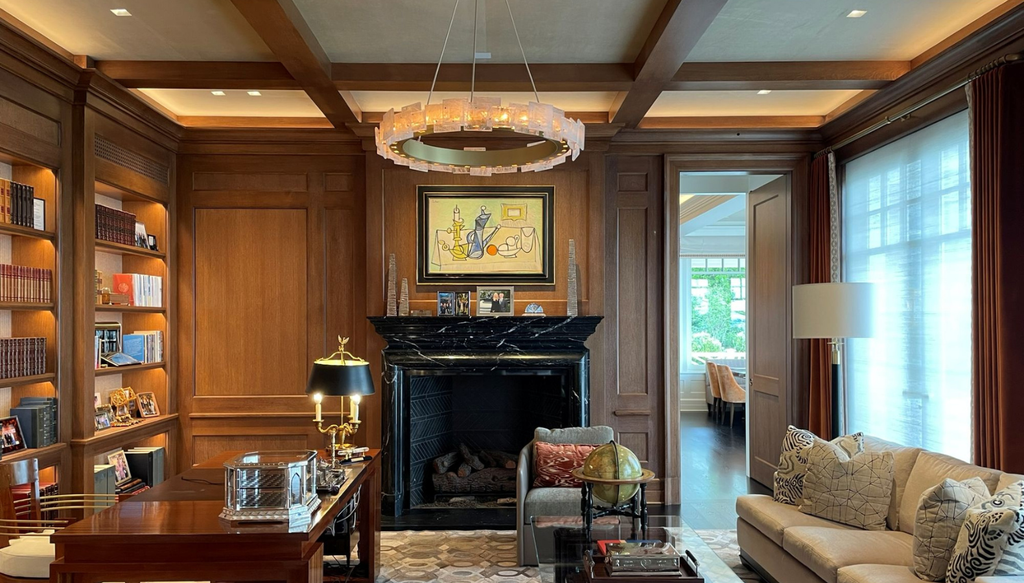
Romaniello started his career in theater. He earned a degree in theatrical design from the University of Connecticut, falling in love with lighting design during his studies. He worked on Broadway for a time, then moved to Connecticut where he worked for lighting showroom, learning about commercial and residential lighting. While working there, he established a lighting design subcompany and eventually launched his own firm nearly three decades ago. Seeking better weather, Romaniello and his wife moved to North Carolina about 10 years ago. A priority for the relocation: being close to a hub airport. With projects all over, he flies out of Charlotte Douglas International Airport on a nearly weekly basis.
Only about 10% of construction projects include a lighting designer’s work, says Romaniello, who is an evangelist for the profession. He encourages others to go into lighting design to help meet the demand for a field that, compared with architecture and interior design, is in its infancy.
At any one time, Romaniello and his colleague Jodi Pfister have about 75 active residential and commercial projects, charging an hourly rate based on a defined scope of services.
“I’ve never felt that lighting design should be exclusive only to the uber rich,” he says. “Everybody should have good lighting. I light my house the same way I would light it for my clients. I just don’t use the uber-expensive fixtures because I’m not a multi-gazillionaire,” he says with a laugh. “But the process and the technique and the placement are the same.”
But Romaniello does work on many ultra-luxury projects, including a 70,000-sq.-ft. home in Michigan.
The recent project in Nova Scotia had a lot of cove lighting and decorative fixtures, in addition to 200 recessed fixtures, but “I’ve got a project in Massachusetts in about a month, and there’s close to 350 there. It’s about a 15,000-sq.-ft. house, so not much bigger square footage wise, but there are more fixtures so that makes it a little bit more of a challenge,” he says.
Most often, Romaniello is involved in lighting design throughout a project — from the creation of architectural plans to the aiming of the lights in the finished space. Another 35% to 40% of his work involves one or two stages of a project, or a smaller task, like reviewing lighting plans from architects or interior designers who want an expert eye.Architects typically hire Conceptual Lighting, although audiovisual integrators and interior designers also bring the company in on projects, Romaniello says.
In part because he follows the code of the International Association of Lighting Designers and in part because he thinks it makes ethical sense personally, Romaniello doesn’t sell or supply any products and doesn’t receive compensation for the sale or specification of products.
“In the projects we work on, most of the recessed fixtures are around $400 each. That’s not the $50 Home Depot light. So, if I’m trying to explain to a client why that’s important, then I need to be able to give them the reasons for that objectively and ethically,” he says. “If I was getting 15% on a $300,000 lighting package, I think that would taint their opinion (of my recommendations).”
And why might he specify a $400 fixture over a $100 or $200 fixture?
“I can look at the characteristics of each one and say, ‘This one only gives you this amount of light and it can only angle 20 degrees. But this one gives you more light, better color, better color rendition. It dims better and can angle 40 degrees instead of 20 degrees,” he says. “That’s why I specified it, not because I’m making money on it.”
Lighting education
Most homeowners – and even many architects and interior designers who don’t receive much lighting education in their coursework – go in one of two extremes when lighting homes, Romaniello says. They either over light or under light.
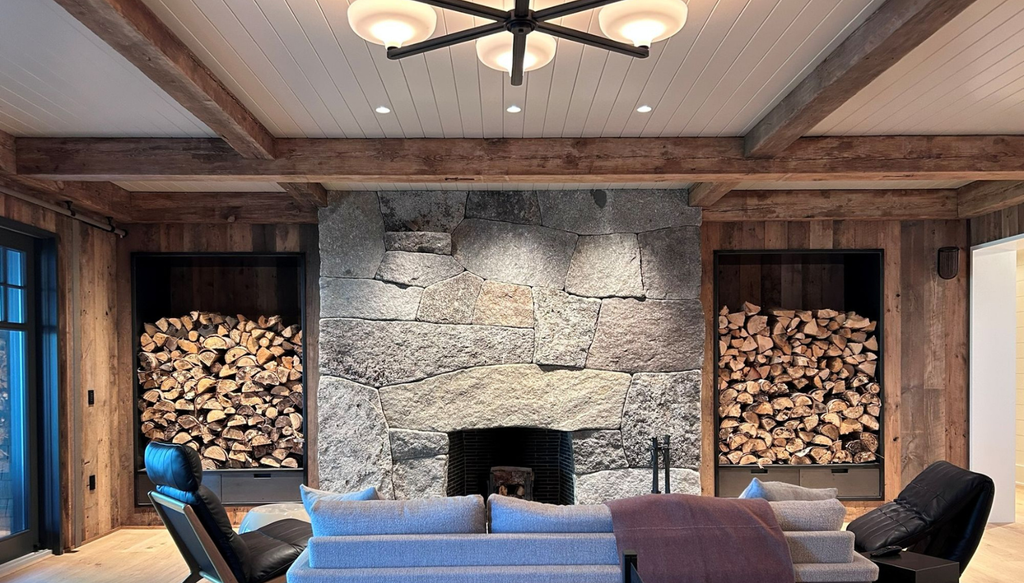
“They think, ‘I’ll just put a bunch of lights in here and put them on different dimmers and then they can have flexibility. But the reality is you over lit the space,” Romaniello says. “Or, let’s say you have a 7′-wide stone fireplace and they put one recessed light there. That one recessed light is never going to showcase that 7′-wide fireplace that should be the focal point of that room in the evening. Instead, you get a stupid little ball of light in the middle.”
It’s Romaniello’s job to provide the Goldilocks “just right” level of lighting.
“Lighting should be understated. It should make the house feel comfortable. It should never be ‘glarey.’ It should have the flexibility to brighten and dim,” he says. “One of the analogies is with sound: You don’t just put one big, loud speaker in the middle of the room and say, ‘Hey that’s great! I can hear everything!’ It’s [about the] little speakers and a subwoofer and hitting different parts of the room. Then you don’t have to turn it up really loud because the sound is all perfectly balanced. Lighting is the same way. Lighting is a mixture of general lighting, accent lighting and task lighting – all at different levels – that allow you to have a well-lit room that’s not an overly brightly lit room.”
Romaniello believes homeowners generally skimp on recessed fixtures “because they don’t understand them.” He wishes HGTV, Magnolia Network and other home-focused TV programming would spend more time on the importance of lighting design, and he once pitched a series idea to HGTV.
“Alton Brown, in his show ‘Good Eats,’ was able to explain the science of cooking and the science of food in an educational way that was also entertaining,” he says. “That has to happen with lighting. It could be a little five-minute segment like, ‘This is color temperature. This is how it affects your space.’ You could say, ‘Here’s a kitchen that’s lit like crap and here’s the exact same kitchen with better fixtures, better under-cabinet lighting.’ It’s hard to do that in print. You can’t do it in radio or on a podcast. It has to be on TV.”
Better education for consumers, he believes, would lead to the purchasing of more and better lighting — and more beautifully lit spaces.
Romaniello’s focus is on the architectural lighting – the recessed, cove, under-cabinet and art lighting – but when he’s designing the lighting for an entire home from the start, he’ll specify where fixtures such as pendants and sconces should go.
“When we’re planning, we’ll say, ‘We want to have wall sconces along here or we want to do a chandelier,’ and the interiors designers are typically the ones picking out those fixtures,” he says. “We’re usually not counting on them to provide light. We’re counting on decorative fixtures to be pretty.”
Making strides
Romaniello appreciates the strides LED fixtures have made since the “Wild West” of 10 or 15 years ago, when the focus was on lighting efficacy standards and not factors like color temperature, color rendition and the quality of the illumination. But all those elements have been improving, especially in higher-end fixtures, he says.
He also appreciates advancements in lighting control technologies.
“For years and years and years, if you wanted a lighting control system, it had to be this big, expensive thing and cost hundreds of thousands of dollars and you’ve got to hire an AV integrator to do it. But now people have the ability to say, ‘Alexa, turn my lights on,’” he says.
“Technology has also allowed us to do things that we couldn’t do before in terms of smaller fixtures, more discrete fixtures. Linear LEDs have gotten so small and so good,” he adds.
But lighting designers shouldn’t get so caught up in new technologies that they lose track of solid design principles, Romaniello says.
“(Technology) shouldn’t replace good design,” he says. “I should be able to look at a house I did in 2008 and think, ‘Yeah, it’s still really good.’ You can tell when lighting designers shove a bunch of linear LED fixtures into a house just because they think they can. That’s trendy and anything trendy goes out of fashion,” Romaniello continues. “But a really nice suit always looks like a really nice suit. That’s the way I approach my work. It has to be really good, well-thought-out design, and then you find the best fixtures with the right technology to accomplish it.”
Related articles
