Maxim Group and Kichler are the two lighting brands featured at the reimagined Design Hub…
Read More →
Maxim Group and Kichler are the two lighting brands featured at the reimagined Design Hub…
Read More →
KBB magazine’s recent webinar “The Essential Role of Lighting in Residential Design” provided insight on…
Read More →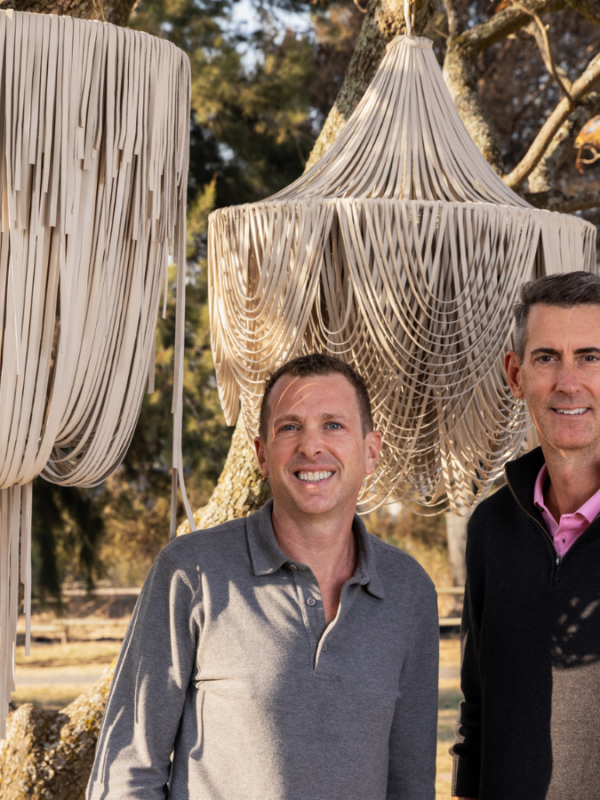
A long-time High Point Market exhibitor, Ngala Trading will open a Dallas Market Center showroom…
Read More →
New exclusive Consumer Insights Now research shows this is a need-driven generation that likes to…
Read More →Lighting design at the home furnishings brand grows out of the collaboration of founders Carla Regina Zajac and James Andrew Slaven. Like many married couples, the two play off each other’s strengths and differences: Zajac’s artistic vision, whimsy and vintage vibes; Slaven’s musicality, fascination with mechanics and boundless energy.
By Julie A. Palm
As founders and owners of Regina Andrew Detroit, Carla Regina Zajac and James Andrew Slaven have wide-ranging responsibilities running the home furnishings brand.
But one task takes priority: design, says the duo, which leads the creative team at the Detroit-based company.
“We do have a lot of obligations on the side of finance and budgets and leases and all the things that go along with running a business,” Zajac says. “But our primary goal is creative. We come in … and we’re ready to do creative work.”
The lifestyle-driven brand founded in 1998 offers lighting, furniture, decor and rugs, as well as its One-of-One line of one-of-a-kind artisanal works, a jewelry line inspired by lighting details and special programs for hospitality customers. But lighting is at the core of the company — about 80% of the company’s sales is lighting related, Slaven says.
“I think our perspective (in lighting) is quality design and a unique ability to put … things together so that it becomes a focus of the room, but it doesn’t overtake the room,” Zajac says. “We’re easily placed and curated throughout a home, along with other Regina Andrew products, so you can layer them in.”
Customers, she says, appreciate the brand’s natural materials, color selections and ceramics. “It’s a very tactile, organic, natural, kind of modern feel, with still a nod to the past,” she adds.
The creative force
Zajac and Slaven often work at the company’s atelier, which has woodworking, metalworking, sewing, jewelry making, 3D printing, molding and other capabilities.
“We can use this facility for proof of concept,” Slaven says. “We create a design then we can go out into the workshop, prototype a little bit. So, when it’s time to take the product design overseas, we have something in our hands physically.”
Zajac and Slaven are continually creating — adding to and subtracting from a series of mood boards that help guide product development.
“We never want to put the kibosh on anything,” Slaven says. “… Things can come out left field, and I never want to let those things go. They just go on the board maybe for later development. … We don’t force it.”
“I consider myself the collaborator in chief,” Slaven continues. That collaboration often starts with Zajac, but the couple also works with their marketing team, looking at trends and customers’ buying patterns. In addition, they consider what customers are seeking, often based on conversations during furniture markets, and work with third-party designers to help take concepts from ideation to manufacturing. And the company recently launched a brand ambassador program with 10 interior designers, who can also provide product development input. The latest additions to the group include Amber Guyton of Blessed Little Bungalow, Brittany Hakimfar of Far Studio, Emily Moss of Emily Moss Design, Avery Carter of Avery Carter Design and Kristen Elizabeth of Kristen Elizabeth Design, who joined a roster including House West Design, Gray Space Interiors, Windsor Dalton Design, Claire Thomas and Allison Handler Design.
Zajac is old school when it comes to product design. “I’m pencil and paper, notebooks, sketchbooks,” she says. “I always have some type of doodle going on somewhere on a scrap piece of paper.”
“Carla is particularly gifted with the doodle, the sketch, the initial idea,” Slavens says. “… She always has a sketchbook and, with just a few lines, captures a feeling. I drive off being inspired by the feeling of a sketch she’s done.”
Slaven, on the other hand, gravitates toward tech: design software, 3D modeling, 3D printing.
“It’s a multipronged approach,” he says. “Sometimes it doesn’t need that. Sometimes a napkin sketch may do just fine, but it’s nice to have those assets, and it’s very helpful to communicate a more complex design.”
Inspired design
As for many product designers, travel is a source of inspiration for the couple, not just because of the new environments, but “you’re away from your day to day, and you can kind of open your mind up to other things,” Zajac says. “It’s having that time to disconnect.”
“There’s also fashion and music, and we like to go to a designer show house. If we’re in an area visiting and one is open, that’s a great source of inspiration for us,” Slaven says, adding, “inspiration can be found in a small detail of a piece of clothing or it can be found in an airplane flying over an interesting building that draws our attention to the spire on the top of the building.”
Rhoads, a lighting collection introduced at High Point Market in April, was inspired by a guitar pick.
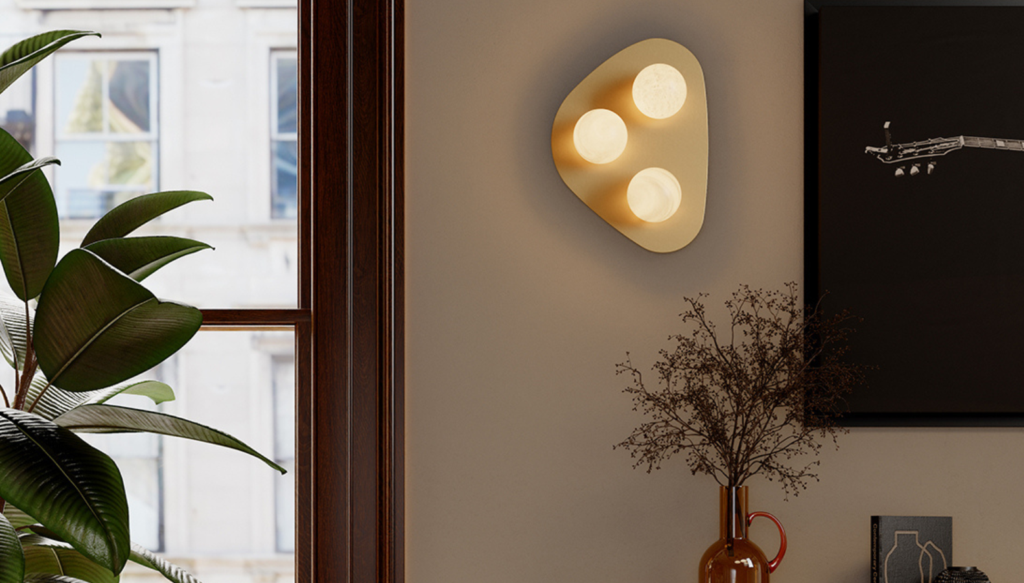
“We said, ‘That could make a great canopy or ceiling plate,’” Zajac says. “A lot of other lighting companies don’t pay attention to the ceiling plate, but it’s those small little details that I think our customer comes to Regina Andrew for.” Available in natural brass or oil-rubbed bronze finishes, the line features alabaster globes.
Rhoades began with the idea for the chandelier, but a sconce is often the starting place for a new lighting group. “There’s something about sconces,” she says. “They’re just like this little earring or something — they’re kind of special and they can also be the spark for a collection.”
In April, Regina Andrew also expanded its Polly lighting collection – a favorite of Zajac’s – by adding new shade colors.
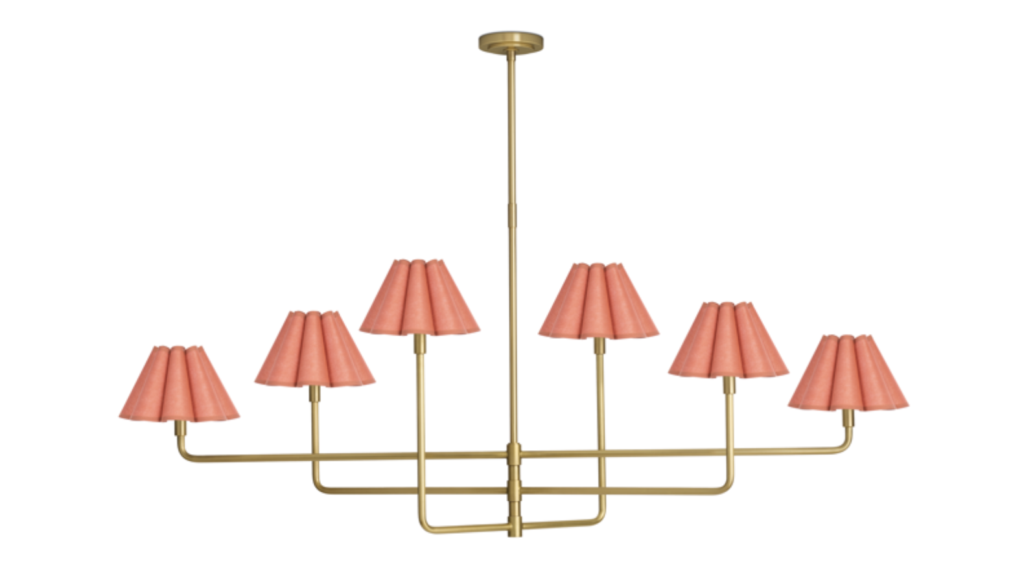
“It’s such a great blend of Jimi and Carla,” she says. “It has this functional, multiarmed, tiered chandelier with arms that can be adjusted, so there’s a lot built into the frame (that’s Jimi) and then there are these cute little whimsical colorful shades on top, and that’s kind of me.”
The full collection, in natural brass or blackened brass finishes, now encompasses a chandelier and sconce, plus table and floor lamps. New shade colors include Wild Poppy and Mist Blue. “I think it’s a great collection that has broad appeal,” Zajac says.
Slaven says he has a hard time picking a favorite design from Regina Andrew’s current line — because his mind is always focused on what’s ahead. But, as Zajac notes, Slaven has a fondness for the company’s mechanical innovations, especially pieces that pivot, tilt, rotate and articulate.
“I also like things that appear to have a history to them, but they’re not on-the-nose midcentury or Italian or something,” he says. “They are our take.”
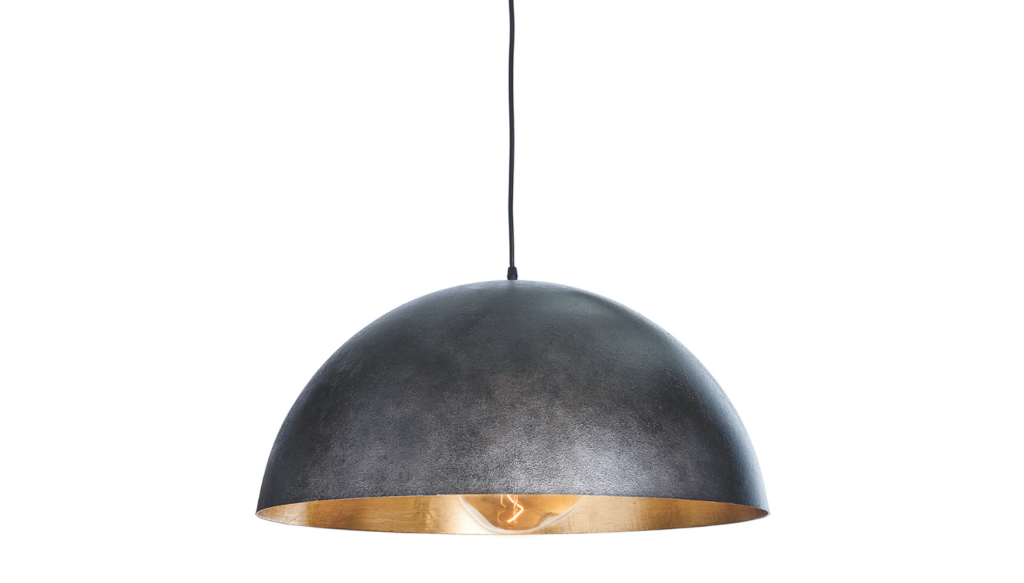
One example: the Sigmund pendant, “which is a dome with beautiful gold leafing inside,” Slaven says. “… It’s something I really love because it’s just a perfect size and a perfect product for all kinds of environments.”
“We always show it with some custom light bulbs that we did that we call a Molten light bulb, where it’s all melted looking. It has an LED filament inside and it’s tinted, so it produces a beautiful amber glow,” he explains.
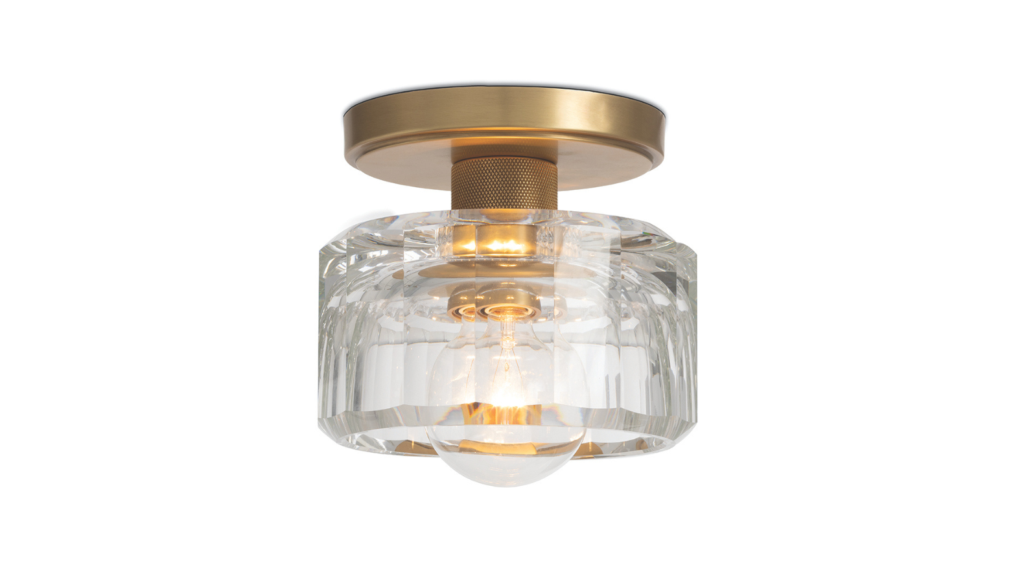
“Another favorite is the Bijoux pendant,” Slaven continues. “It’s a very versatile solid crystal pendant and flush-mount that can be a sconce. … It reminds me of my rocks glasses, and that’s what inspired it — my Scotch glass.” The company will be expanding that collection, which also includes a flush mount/scone option, with an eight-light chandelier using those same chunky cut crystal globes.
Customer-friendly creativity
Regina Andrew launches new products at the biannual High Point Market, but the company notes that new products are posted online 30 days ahead of the shows.
“So, we begin showcasing and telling the story,” says Chief Marketing Officer Neil MacKenzie. “… What’s great is that if you’re not coming to market, which not everybody is, you still have access. … We set up virtual appointments for folks that aren’t going to come, so if you want to have a virtual walkthrough to get a sense of scale, we’ll do that, too — anything that makes it easier (for customers).” At furniture markets, the company now provides scanners for those who prefer a self-service tour of the showroom, which is entirely shoppable. Of course, company sales reps are available to help customers with walkthroughs and order placement, too.
What’s next
When it comes to interior design trends in general, both Zajac and Slaven see a move away from clearly defined styles like industrial, farmhouse or coastal and toward more sophisticated takes on such aesthetics.
And “eclecticism has become kind of an ingrained thing in people,” Slaven adds. “There’s also a movement in the young generation that anything popular isn’t popular.”
What can customers expect from Regina Andrew in the fall? New offerings will include ceramic pendants and a lighting collection inspired by an espaliered pear tree the couple planted at their home, Zajac says.
“Master gardeners grow these trees over years to create these beautiful, candelabra-like, chandelier-like structures,” she says. “So, we have a collection coming out based on our little tree.”

Related articles
Behind the Design: Jamie Young Co.
