Maxim Group and Kichler are the two lighting brands featured at the reimagined Design Hub…
Read More →
Maxim Group and Kichler are the two lighting brands featured at the reimagined Design Hub…
Read More →
KBB magazine’s recent webinar “The Essential Role of Lighting in Residential Design” provided insight on…
Read More →
A long-time High Point Market exhibitor, Ngala Trading will open a Dallas Market Center showroom…
Read More →
New exclusive Consumer Insights Now research shows this is a need-driven generation that likes to…
Read More →When it comes lighting, Emily Winters Posselt craves the artistic and unpredictable — and has very specific feelings about Kelvin temperature.
By Julie A. Palm
For interior designer Emily Winters Posselt, lighting is both architecture and jewelry. So, when designing a home, she starts with the architectural aspects, wanting to know early on how fixtures will illuminate and interact with the key elements and features of a home.
From a practical standpoint, she also wants to ensure that a home can structurally support – and is wired properly for – larger fixtures.
That means she has all key lighting picked out by the time she’s doing the rough electrical walk-through with contractors. “I like to preplan and not have to take three steps backward later,” she says.
Posselt is principal interior designer for Peabody’s design firm, based in Milwaukee, Wisconsin. In addition to providing full-service interior design, Peabody’s operates an 8,000-square-foot retail showroom, and Posselt does some of the buying for the retail arm of the business.
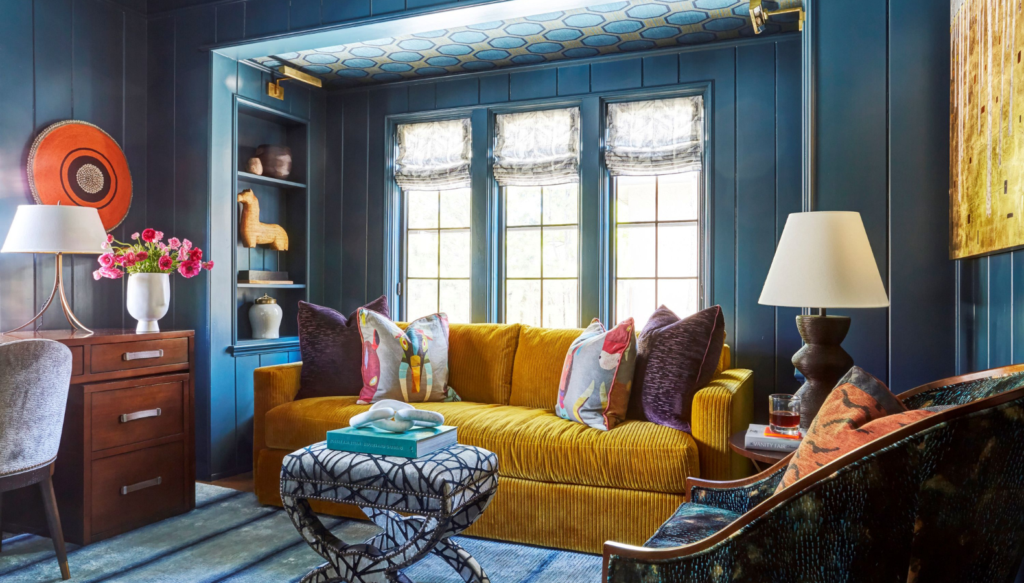
She also leads the Peabody’s team that specializes in new construction and whole house renovations. “I’m hired at the same time as the architect,” she says. “I’m touching literally every piece of the house — from the flooring to the surfaces to the cabinetry and hardware to the furnishings, lighting, accessories and window treatments. I also consult on art.”
Often, Posselt says, she works with a lighting designer on projects. “If I’m fortunate enough to have a lighting designer, I’ll let them worry about the architectural lighting and then I’ll look at the other decorative lighting as jewelry. But, if I don’t have a lighting designer, I’m thinking with both sides of my brain: lighting as practical and as jewelry — the statement, interesting pieces.”
Lamps come much later in the process.
“Those are often at the very end, in part because clients have a hard time conceptualizing a lamp based on a tear sheet,” Posselt says. “So, often I’ll sit down and do a stock order of lamps and other accessories with a specific client in mind two or three months before an install. About 90% of what I order ends up staying in the client’s home. And, for the rest, no problem: I’ve got a retail space where I can sell it.”
To shop for lighting, furniture and other accessories, Posselt appreciates the antiques fair in Round Top, Texas. “My most inspiring show is Round Top,” she says. “Why do I love it? It’s the interesting pieces and all the one-of-a-kind items. … I love the variety of it. Not everything is antique, but I love the artistic flavor there.”
She also tries to make a trip to the High Point Market and the Atlanta Market at least once a year and she occasionally pops into The Mart in Chicago.
When it comes to favorite lighting vendors, Posselt says, “I’m kind of all over the place.”

“But I love Urban Electric. I use them for a lot of lighting,” she says. “I also love vendors like Gregorious Pineo and then I fill in with Visual Comfort. I just think they have cornered the market on quality for the price. And I use Paul Ferrente for a lot of custom pieces. And Vaugn is another: When I’m doing an older Wisconsin home especially, Vaughn is sometimes a go-to for me.”
Wherever she’s sourcing lighting, Posselt is looking for fixtures and lamps that are “unique.” “Something that feels a little modern or artistic and that’s not predictable,” she says.
She allocates the bulk of most project lighting budgets to “front of house” living area and the kitchen, with the rest spread out among bathrooms, bedrooms and other spaces. “I think it’s super-important that the kitchen is well-lit and that it makes a statement because we spend so much time in our kitchens,” she says.
Posselt is very particular about two aspects of lighting: She wants every fixture to be dimmable “because lighting control is super-important.”
And, she says, “I’m a stickler about 2700K for my color temperature. It just has to be a warm light,” she says. “These houses you drive by that have sort of glowing blue light make my eyes spin. I’ve got to have a nice warm light.”
Related articles
