A special meet-and-greet event with interior designer Nikki Chu highlights her debut lighting collection with…
Read More →
A special meet-and-greet event with interior designer Nikki Chu highlights her debut lighting collection with…
Read More →
During the recent ALA Conference, members were updated on the current and pending legislation and…
Read More →
The interior designer tells Style Editor Julie A. Palm that warm finishes, cordless rechargeables, and…
Read More →
The multi-month program provides education, tips, and support for independent retailers. Dallas Market Center (DMC)…
Read More →Style Editor Julie A. Palm offers an example of why the American Customer Satisfaction Index dropped sharply in the second quarter, with customer complaints at record levels. What are you doing to keep your customers happy?
By Julie A. Palm
I have had three folders on my computer all labeled some version of this: “Soda Stream Problem December 2025.” Last week, I added the fourth – and what will be final – folder. Final because I am no longer a Soda Stream customer.
Soda Stream makes machines that carbonate water. I love fizzy drinks but thought it was wasteful to buy so many cans of seltzer, so I switched to the Soda Stream system years ago. When the bubble-making CO2 cartridges run dry, I order more online. They ship me full canisters and I ship back my empties in the same box, using a mailing label they provide. Except for a few glitches during the supply chain strains of the Covid-19 pandemic, it’s been a nifty process.
That changed late last year when the company started losing track of my returns, triggering email reminders to send back my canisters. Each time, I would message customer service with proof the package had been delivered back to Soda Stream. It took a while for me to write and document each email — and, as you might guess, it was super annoying. “They had the tracking number. It was on the label they sent me. They could have configured their system to track the package themselves!” I muttered to myself with more profanity than I feel comfortable sharing here.
I went through this four out the past five times I returned CO2 cartridges. This week, Soda Stream charged me $30.60 for failing to send back two of them. Cartridges I had returned! Cartridges I had proven to them that I had returned! I emailed customer service yet again and demanded the charge be reversed. Within a few hours, the company had done so.
I will give them credit for that. But I am done.
I am not alone
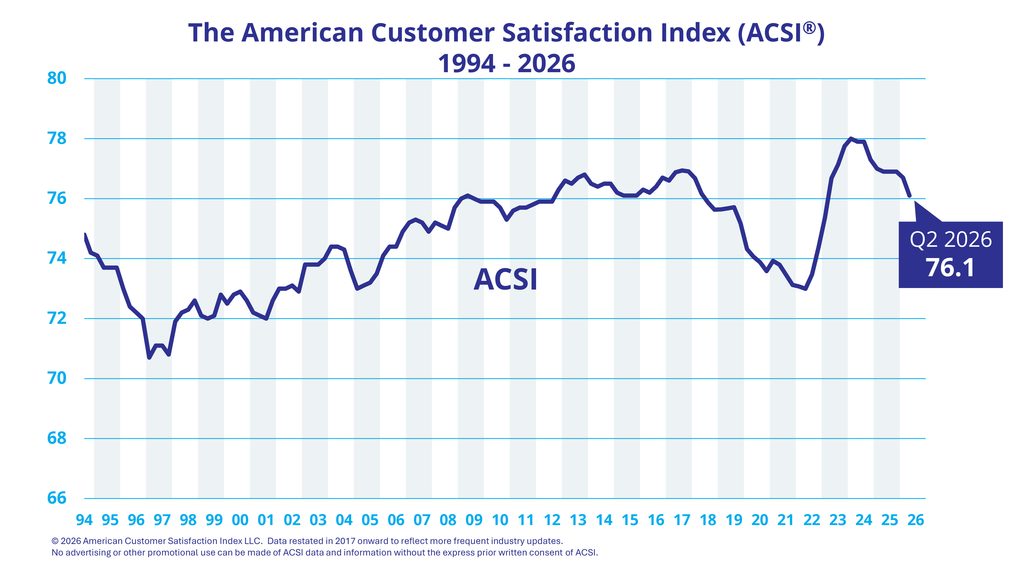
The American Customer Satisfaction Index dropped sharply in the second quarter of 2026 to 76.1 on a scale of 100. And, the producers of the index note, customer complaints are at record levels.
The latest 76.1 figure isn’t the lowest number ever recorded since the index was created in 1994 (consumers were very dissatisfied in 1997). But the rate of the drop seen between the first and second quarters of 2026 has been steeper only one other time since 2000. That earlier abrupt drop came when the Covid-19 pandemic pushed up prices and constricted supply chains, according to the ACSI, which is produced through the University of Michigan’s Ross School of Business.
The satisfaction number also dropped, albeit at a lower rate, in the first quarter of 2026. At that time, the producers of the ACSI noted that customer satisfaction had enjoyed an “upward drift” from 2000-2013 but since then, it has been much more volatile. A slow decline began around 2017 and accelerated in the 2020-2021 pandemic period. Customer satisfaction began a steady upturn in 2022, reaching an all-time high of 77.9 for two quarters in 2024. It’s been on a downward trajectory ever since.
Customer satisfaction encompasses many aspects of the shopping and purchasing process: selection, pricing, reliability of shipping and delivery, ease of returns, ease of use of e-commerce websites and shopping apps, quality of interactions with in-store salespeople and online customer service reps (or, increasingly AI chatbots) and more.
A bigger problem
In the news release accompanying the latest numbers, the producers of the index note that the nation’s gross domestic product, which is “highly dependent on consumer spending,” is slowing, too, even while being propped up largely by affluent households.
Yet, corporate profits remain high. “At the macro level, the divergence between buyer utility (or satisfaction) and seller profit implies that companies are charging more while supplying less,” according to the producers of the index. “This creates a welfare loss in economic terms, with profits disproportionately going to owners of capital. It is incompatible with sustainable economic growth and occurs due to market concentration, where companies have strong pricing power and customers face significant switching costs” (Italics mine).
But eventually frustrated, unsatisfied consumers will switch to another brand or a different retailer — or they’ll stop buying discretionary items completely. (For now, I’m going back to buying seltzer in cans, stocking up when my grocery store puts their brand on sale.)
No wonder the authors of the ACSI news release headlined it, “Economic Alarm Bells Are Blasting — Is Anybody Listening?”
Risks to individual companies – and the broader economy – can be mitigated “by improving the buying and consumption experience of customers,” they say. “… However, many companies use performance metrics that are too noisy or irrelevant for improving customer satisfaction.”
“If the pent-up customer defection materializes, companies with both high customer satisfaction and high customer retention will benefit not only from downside protection, but also from strong stock returns,” said Claes Fornell, founder of the ACSI and the Distinguished Donald C. Cook Professor (Emeritus) of Business Administration at the University of Michigan. He’s talking there about large companies, but what he says next applies to companies of all sizes: “It is customer retention, particularly at high levels, that causes exponential profit growth. Long term, it is better that such growth comes from satisfied rather than captive customers.”

Lighting showrooms are dealing with a slow housing market and inflation, two things you can’t control. You have more control over how you serve your customers — how well you merchandise product in-store and online, how easy you make it to purchase and return items, etc.
How much effort are you putting into customer satisfaction right now? And how are you measuring it? If the ACSI is correct, your success or failure depends on it.
Related articles
