AI has gotten a bad rap lately, but Laura Abney of Google shared some very…
Read More →

Many of the new lighting designs that debuted at High Point Market featured highly textured…
Read More →
Students toured the fall market to learn more about the industry and take part in…
Read More →AI has gotten a bad rap lately, but Laura Abney of Google shared some very specific advice for lighting showrooms and manufacturers attending the ALA Conference to help them stay top-of-mind with customers.
The species that fail to adapt are the ones that become extinct. Variations on this idea have been expressed at many business conferences in the past, but at the recent ALA Conference in Tucson, the message hit home with manufacturers and showrooms in the audience. The keynote speaker was Laura Abney, an AI business strategist at Google who researched the challenges lighting showrooms face and presented some straightforward tips ALA members could implement when they returned home.
Abney likened the situation the lighting industry faces to the “Red Queen hypothesis,” a term coined by evolutionary biologist Leigh Van Valen that references a passage in Lewis Carroll’s Through the Looking-Glass (the sequel to Alice’s Adventures in Wonderland) where the Red Queen explains the nature of Looking-Glass Land as: “Now, here, you see, it takes all the running you can do, to keep in the same place.”
Abney said, “What they’re trying to describe is the idea that in evolution, you’re constantly running just to keep up — not really to get ahead. It’s the idea that if you don’t keep moving forward, you don’t just fall behind…you go extinct.”
She continued, “I think this is the perfect parallel for what it feels like to run a business over the past 20 years. It’s been so intense. All of a sudden, there was digital and then mobile and e-commerce and CRM and websites and social. Each year there was a new thing that we had to evolve and adapt to. And what was happening is that you think that you’re running, and you think you’re doing everything you can do…just to find out that your competitor is doing the exact same thing. All these investments you made actually just kept you in the same place.”
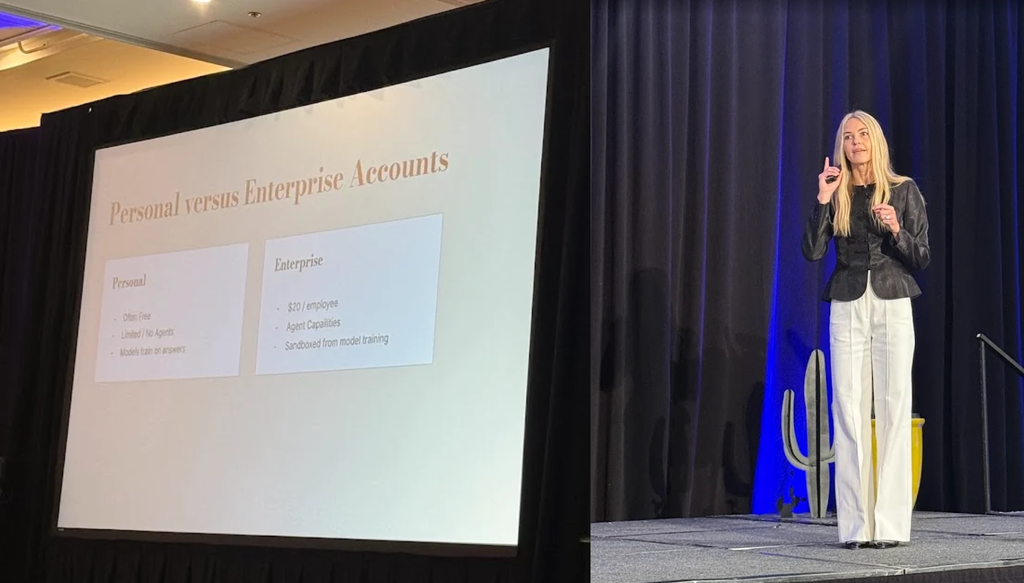
Despite that frustration, Abney said she feels optimistic. “Because in evolution, every once in a while, there’s a genetic mutation. And this genetic mutation doesn’t just offer a little bit of incrementality. It changes the ecosystem entirely. It’s like when a species gets legs so that they can walk on land, or wings so that they can take flight,” she explained. “I believe that in business, AI is that genetic mutation. It’s an opportunity to break out of business as usual. It’s the opportunity to just change the game in the way that we work and the product that we give out. I think it’s our opportunity to just expand and evolve in a way that we have never had before.”
According to Abney, there is “an outsized opportunity” right now for companies that are starting to utilize the tools and technologies of AI. “That opportunity will only exist for as long as it takes the rest of the ecosystem to catch up,” she remarked.
With that groundwork set, Abney shared some of the tools and technologies that she believes will “help move your personal life and your business along, so that you are now flying and not just running a little bit faster. Let’s change the game entirely,” she said. “We’re not just sitting around campfires talking about how crazy AI is. Well, we are, but it’s not a future state. It’s happening right now — and it’s impacting some of the greatest and most important facets of our life.”
With the advancements in technology, “we have a new tool belt. We have increased our capability, but we’ve also elevated our expectations,” she explained. “We now have the AI-empowered consumer. And yes, we are all this consumer. We want our experience to feel personalized and predictive and pleasant. The AI-empowered consumer is changing the way that we want [things] and our expectations are meaningfully different in this time.”
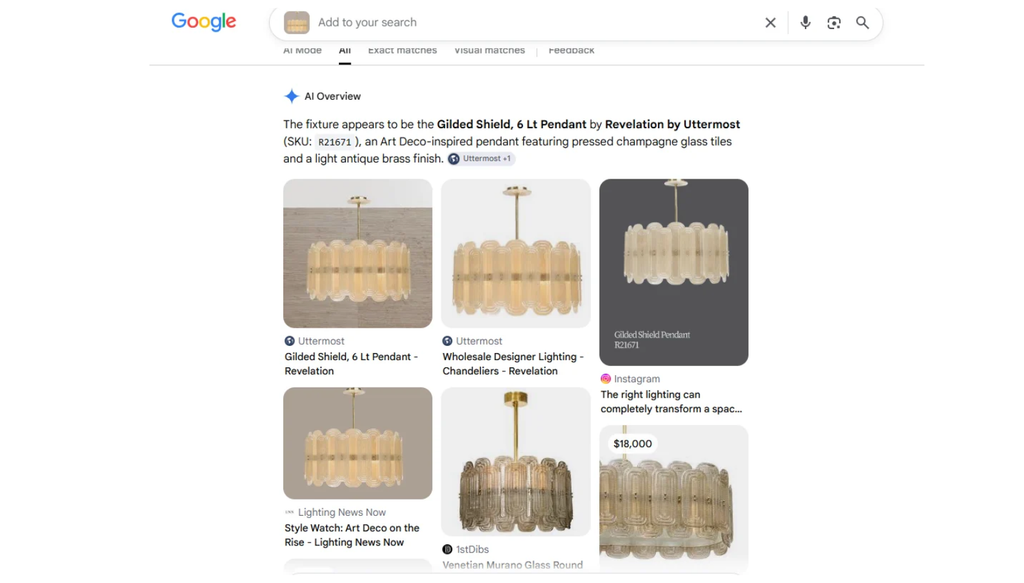
Abney recounted her own experience trying to buy a floor lamp that she saw when she was on safari in Africa. She took a photo of the lamp on her phone and uploaded that image to Google Lens.
“Instantly, the system is not trying to match keywords; it’s trying to match the image. And all of a sudden it’s giving me answers: What is this product? Where can I find it? And it’s comparing that image to others and ultimately getting me to the exact websites where I can purchase this product that I saw in Africa,” she explained. “Every month there are 25 billion visual searches, and one in four of those has commercial intent. So, as business owners and operators, it’s wildly important that you make sure that your brand is searchable — and that requires [good] imagery.”
[Editor’s Note: Google also offers a Merchant Center service for sellers that causes their products to appear organically in Google’s Image Search, Lens, and Shopping results. Lens on the other hand, is a free tool and primarily looks for an exact image match.]
Abney explained that conducting transactions in AI is still in development. “Part of what I do at Google is work through one of the partnerships that we’re building for agentic commerce,” she said. “What do actual consumers want that to look like? What we’ve heard from users is that buyers don’t want AI making the decision to purchase for them. What they want is help getting through the ‘messy middle’ of being a shopper. There’s like this huge tax that exists to find the things that you really want. And users are very willing to have AI help them get from an idea to a want and then having what they desire.”
According to Abney, the past 18 months have had the biggest changes in search and shopping in Google.
“We went from getting those little blue links [under a search] to getting answers, using Lens to instantly find what I’m looking for, having conversations within chat that are useful and helpful, making decisions by having viewing custom renderings to decide if this product is right for me, and then taking action, setting a price alert, and soon actually purchasing [that item],” she said.
This evolution literally has changed how businesses operate, Abney explained, because billions of Google users have access to these tools. “That elevated expectation that consumers are having [at retail] is because big tech companies are giving them free tools. They’ve changed the way that we all want. And so – unfortunately and maybe fortunately – that elevated expectation comes to you,” she told ALA members. “Because now, across every industry and every interaction, these AI-empowered consumers expect this type of ease, utility, helpfulness when they are interacting with brands.”
After taking the audience through the shopper’s experience with AI, Abney proposed the opposite view. “Let’s flip the camera around. Pretend that [we’re at] your desk because almost every user journey that we just talked about has a mirror application for you and your day,” she said. “There’s all this busy work that it takes for you to get through your day to the outcome that you’re trying to achieve. That is the opportunity for AI. How do we leverage agentic teams to take away your busy work and help you get done what you want to get done?”
The first point that Abney wanted to drive home was that “chatbots” are not the same thing as an AI “agent.” These are not interchangeable words for the same function.
“We’ve all been using chatbots,” she explained. “If you use Gemini or Google or ChatGPT or Claude and ask simple questions, that’s a chatbot. You can have a conversation in there, but it’s a chatbot.”
With an AI “agent,” the skill set is more comprehensive. AI agents are perfect for repetitive tasks. “You teach it how to do something, and it can work autonomously for you and on your behalf,” she said, cautioning, “It should always have a human in the loop so that you’re ultimately the decision maker. But the idea is to take a repetitive task away from you.”
As an example, Abney said a chatbot could explain the difference between a keto and paleo diet. With an AI agent, one could say “Here are my health goals and here are my food preferences. Make me a weekly meal plan and create a shopping cart on Instacart for me to just hit ‘buy,’ and do that every single week, taking feedback from me, introducing new biomarkers, and track my progress on this goal. An AI agent is like a teammate, helping me with something.”
Knowing that distinction between a chatbot and an agent is key. “Agents are really our opportunity,” she stated. “The chatbots are super helpful and we love them. They were like training wheels for us, but the agents are how we change. They are the tools that help transform our businesses, but also us as humans.”
In the grand scheme of improving business operations, Abney suggested that lighting showrooms could create a team of agents. “There’s major power around the ability to put these things together to work on your behalf,” she noted.
Here is how she envisioned several AI agents working for a showroom:
“Let’s say a client sends you a house that they just purchased that they need lighting for.
Most clients’ brains don’t work in a way where they can just envision what those choices could look like. The average humans need to see imagery in order for them to be inspired,” she said.
“In this case, you would call in your AI Design Assistant. You would give the Design Assistant agent an image of the client’s room and say, “Give me three versions of this room. Keep the dimensions, the ceiling height and the windows [as shown].” And almost instantaneously the agent gives you back an organic modern look, a traditional look, and then super-sleek modern,” she explained. “You give those to the client and they get to choose. Let’s say the client chooses organic modern. The Design Assistant is not just here to render, it can help you make a plan. You ask it to build the lighting plan based on this style and that you need accent, ambient and task lighting. And it gives you back a really beautiful, clean plan.” Abney noted that the human lighting designer would come up with fixture ideas plus details such as Kelvin and wattage.
“This is a really beautiful product for you to give to your customer,” she said. “For some of you, this is your specialty and [you know the lighting] technology. That is your bread and butter so for sure, lean into those tools. Specifications technology is amazing and definitely worth investing in for the places where it matters most to you. But if you’re a designer and you want to give a [preliminary] proposal to a client, you would have a huge head start by using your Design Assistant in that manner. And then you get to focus on the things you’re really good at like design and having taste, because AI doesn’t have that yet.”
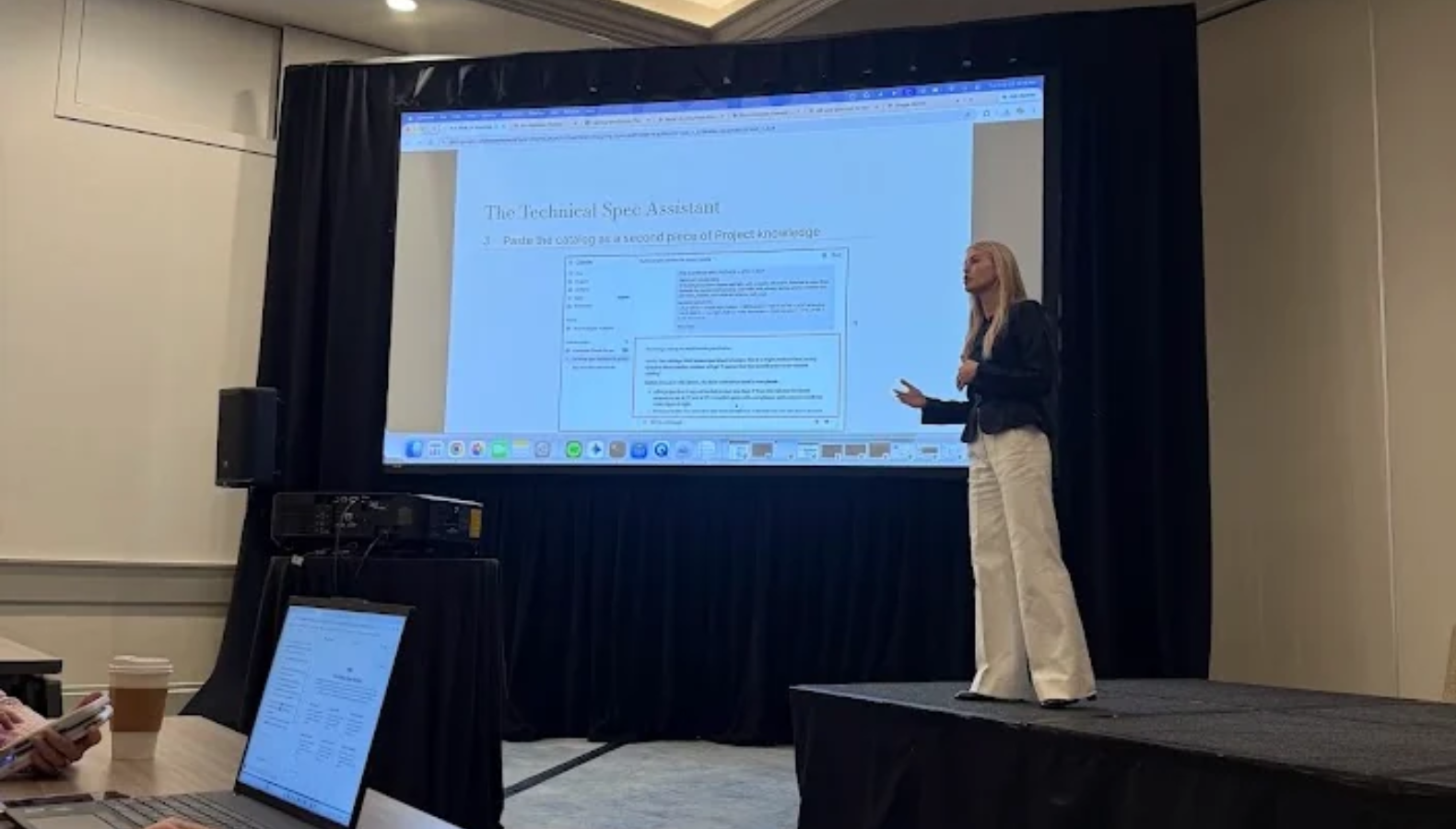
Noting that the lighting industry is very complex with its calculations, such as footcandles and lumens, Abney suggested creating a Technical Spec agent. “I know that if one thing is off in your calculations, it can throw off an entire project,” she said.
Calculations, number crunching and keeping track of spec documents for every manufacturer is where an AI agent that handles just technical specs can save time.
“When you build a Technical Spec Assistant, you’re feeding this agent all of your spec documents, all of your user manuals, all of your brand guides, and then allowing it to learn and remember each of the details,” Abney stated. “So when you’re building a proposal, or you’re answering a question for a customer, or you work in customer experience, or maybe you’re on the showroom floor and need to know a certain specification, you just go to this agent and you ask it in natural language: ‘How many watts is that fixture?’ And it has that answer ready for you instead of you going through all of the user manuals or having to ask someone.”
Abney noted that another good use for a Technical Spec Assistant is for checking your work. “As you’re about to send something out, or answer an email for a customer who is having a problem, you just run it through the Technical Spec Assistant and make sure that you’ve answered the question exactly,” she said.
Other agent responsibilities could be Proposals Builder that takes the renderings from the Design Assistant and coordinates it with the Technical Spec Assistant. “You’re building a customized proposal,” she explained. “With this agent, you’ve already trained it on your brand guide, so it knows what your deck should look like, what font you use, how you build your proposals, and it will instantly create one that is polished.”
Abney theorized that this could save the designer a lot of time and effort. “Instead of time spent pulling slides from different decks, making sure that everything is aligned and that there is a consistent tone, you’re able to build something that feels specific to them and not just plug-and-play. If I have a tool that can help me do that, then I can utilize my brain to think about the strategy that goes into the plan and not spend two hours formatting the proposal [document],” she explained.
Inputting all of the data that an AI assistant needs to do these calculations and set up takes a fair amount of time upfront.
“I think of it like training a new employee,” Abney stated. “If you hired somebody to do repetitive tasks, wouldn’t you spend a couple of hours teaching them how to do it? Think about what the rest of your week could look like, or the rest of your month, when you have all of this help.”
Abney told ALA members that utilizing AI in this way is an opportunity to expand the work that you do and evolve how you operate in the workplace. “It’s not about doing more; it’s about doing better,” she affirmed. Without the burden of spending time on repetitive tasks, Abney said there would be more time available to serve your customers and grow your team.
“It’s about how you are able to do more of the work that you want to do,” she explained. “If you like checking invoices one by one, keep on doing it. But if you’d rather have more time to be creative and strategic, and have a more interesting day, this is [a solution].
The ALA Conference included a break-out workshop session, led by Abney, that delved deeper into the mechanics of how to create an AI agent step by step. Attendees were able to use their laptops, tablets and phones to practice how to set up AI agents on platforms such as Claude and Gemini that they could access after they returned home from conference.
Related articles
Putting for a Purpose at the ALA Conference
Tony Wang Inducted Into ALA Hall of Fame