KBB magazine’s recent webinar “The Essential Role of Lighting in Residential Design” provided insight on…
Read More →
KBB magazine’s recent webinar “The Essential Role of Lighting in Residential Design” provided insight on…
Read More →
A long-time High Point Market exhibitor, Ngala Trading will open a Dallas Market Center showroom…
Read More →
New exclusive Consumer Insights Now research shows this is a need-driven generation that likes to…
Read More →
The company says its “residentially inspired” destination will offer an immersive way to experience Kichler.…
Read More →KBB magazine’s recent webinar “The Essential Role of Lighting in Residential Design” provided insight on how lighting showrooms and reps can leverage their expertise.
KBB magazine, the official publication for the NKBA and its KBIS event, recently hosted the webinar “The Essential Role of Lighting in Residential Design,” sponsored by architectural hardware manufacturer Häfele America. The majority of the audience were interior designers and kitchen and bath designers who were interested in learning more about lighting in order to provide better value and service to their clientele.
The speakers were two award-winning interior designers: Sharon L. Sherman, ASID, CKD, CID, NCIDQ, founder and principal designer of Thyme & Place Design in Wyckoff, N.J., and Toni Sabatino, IDS, SFC and CLIPP-certified principal of Toni Sabatino Style in Northport, N.Y. They were joined on the session by Randy High and Joel Dallin of Häfele America.
Sherman and Sabatino make a concentrated effort to stay up to date on the latest lighting developments by taking courses on color-tuning, chromotherapy, circadian lighting, and the health and wellness aspects of lighting from a variety of trade resources. This knowledge has set their design practices apart while elevating the level of service they bring to their clients.

The webinar provided reasons on why designers should become acquainted with more advanced lighting techniques and applications for greater client satisfaction — and both speakers emphasized the benefit of collaborating with lighting experts on comprehensive plans.
Through their lighting education – which they say has come from being involved with their local chapters of trade associations, online sessions offered by those organizations plus attending trade shows such as Lightovation, LEDucation, KBIS, and CEDIA – they are able to provide their clients with an all-encompassing design plan.
Sherman noted, “For me, lighting is a design element — it becomes part of the [project] conversation from the first step. I’ve taken many lighting courses that are available to many different design professionals, so I can do basic lighting for under cabinets, task lighting and recessed lighting. I know and understand what light does, and the value of light and the proper spacing and wiring of those lights with my electrician. When it steps beyond that basic plan, I call in a professional lighting designer who can speak to a higher level of detail and we work together on that project.”
And just who is that lighting pro? Sherman did not reveal the name, but said it was one of her lighting reps. This, of course, underscores the value for reps and showroom associates to continue to advance their lighting education and leverage that knowledge to become the go-to expert for their local trades.
“Lighting is very important; it affects us as humans. We can create moods by combining warm lighting for social interaction and cool lighting for more alertness and productivity in work areas in the home,” said Sabatino. “I look at lighting as more than having a few decorative pendants and much more in terms of evaluating how people live, work and what they need in order to see better. I think that designers can get overwhelmed by [the calculations of] lux, lumens and foot candles. I love lighting, but if you are getting involved in more than what you comfortably know about it, seek out a lighting professional. There are a lot resources for that.”
Using lighting in different ways
Sherman and Sabatino find their clients are becoming more aware of lighting effects and are open to spending more on them. Here, the designers share some of their best practices as well as some recent installations where lighting is key.
Sabatino doesn’t make assumptions about what a client will or will not spend on. “See what the [budget] range is and don’t sell from the idea that people aren’t going to want [a layered lighting plan] or can’t afford it,” she cautioned. “Allow clients to make an educated decision by informing them of what’s possible. Introduce them to different concepts about how they’re going to live better in their homes. Depending on the size of the project and the budget, you may think this is something they will not want to increase the budget for, but give them that opportunity. It may be something that they’re really interested in.”
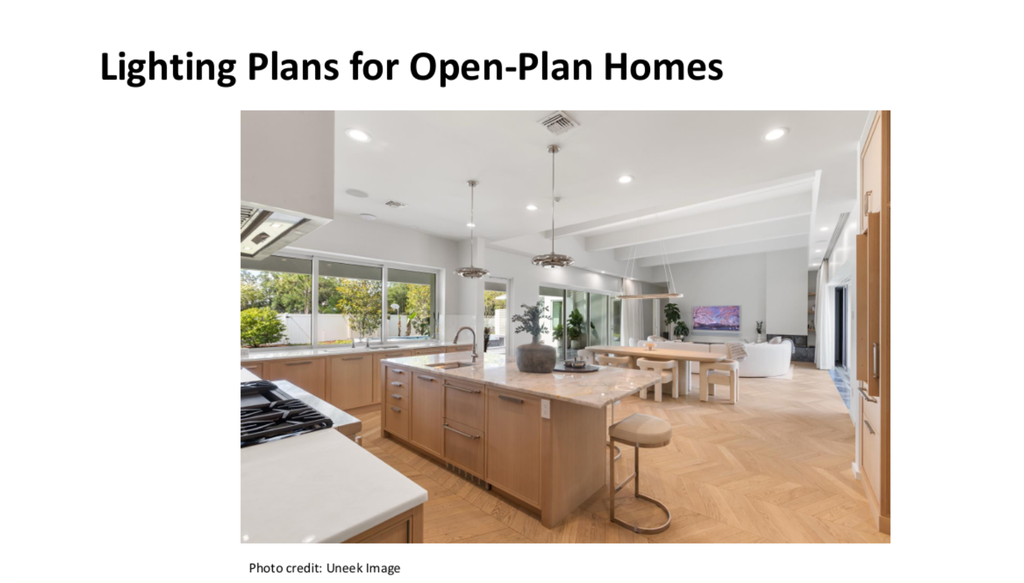
For example, Sabatino pointed to the continuing popularity of the open living space layout. “If you leave it up to the electricians, they will probably run two long sets of recessed cans in the ceiling and think that they did their job because there are enough foot candles hitting the floor and it meets code. But it’s not interesting, and it’s not a great way to live,” she explained. “If we take that floor plan and apply our kitchen task space, and our dining space, and maybe where the sectional is for watching TV, we can illuminate the ceiling in different patterns. That will make each area feel cozier, more comfortable, and really define each part of a large space through the lighting. In essence, the lighting helps us define the architecture.” And when clients see the difference that a more thoughtful approach to lighting makes, they are often on board.
Sherman is working on a project right now that has seven closets. “When it comes to choosing clothing – since most closets are interior spaces – it really needs to have well-rendered light. You need to see the colors of the clothing that you’re choosing so you don’t end up with the old example of one black sock and one blue sock,” she noted. “I think having really good color value in lighting when selecting clothing and applying makeup is important. Your makeup [choices] will change depending on whether you will be outside or inside.” Understanding how color temperature affects skin and clothing color is key to the client’s enjoyment of that space.
In addition to color-rendering, these designers are especially savvy about layering the lighting depending on how the room is used.
“I am doing a gym [in a home] right now and it is going to require different types and placement of light because you don’t want hot spots reflected in the mirrors where clients can’t see what they’re doing,” Sherman explained. “It’s really important to be able to see form and be able to see the equipment.”
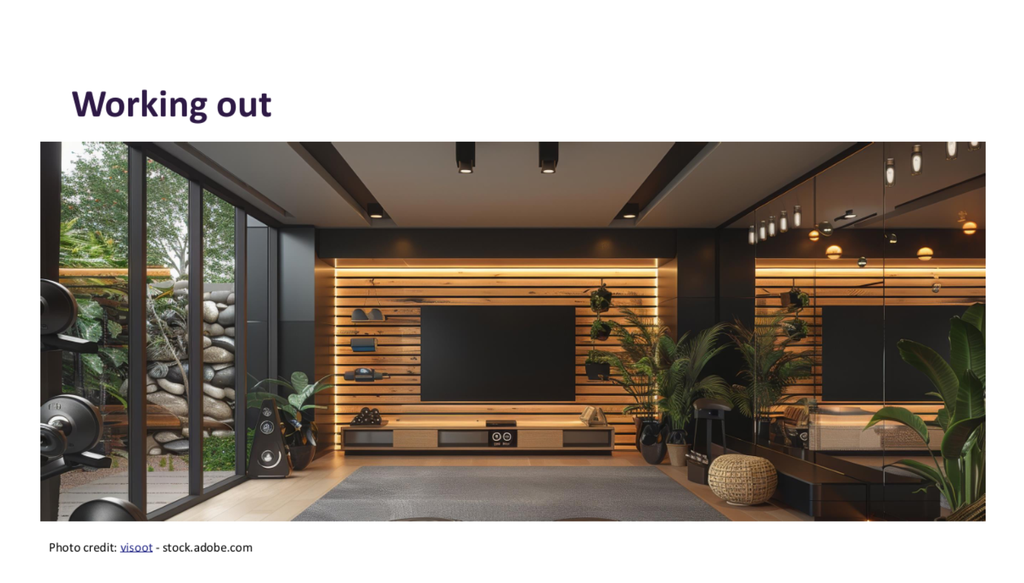
Her lighting solution for the gym involves recessed LED for general illumination. “But then we want to have lighting that can be adjusted,” she added. “So maybe instead of a workout with weights, they are going to be doing yoga. In another gym that we’re doing, there is a steam room. We have a lighting plan where, when they are coming out of the steam room, they’re able to bring the light levels down because they are now in a relaxed state — and you don’t want them to go from this kind of moody space into a completely brightly lit space. That would be a jarring transition. We have some subtle backlighting that goes down a wall and then some directed lighting that illuminates the mats. We also have toe kick lighting in spaces where, if they’ve just come out of a meditation for a moment and want to grab a towel, that meditation isn’t interrupted by having a very intense, very directed light source.”
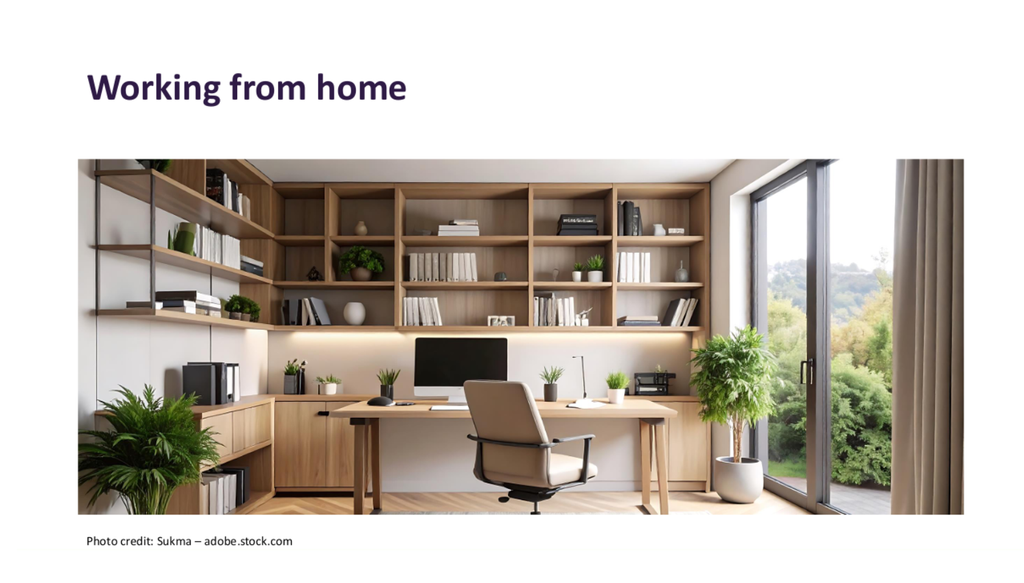
Illuminating home office areas has changed with technology. There is still the need for proper illumination at the desk as well as overhead ambient lighting, however, the proliferation of video calls in home offices has impacted lighting design.
“What’s really important in a work-from-home space is to make sure the screen is illuminated properly as well as having softer illumination behind the person so that viewers don’t see someone who is backlit, where you can’t really see the person,” Sherman said. “Providing forward-facing light and rear-facing light is important and so is being able to control the light around the rest of the room.”
When illuminating a desk area, designers must take into account tasks such as writing or reading something that is not on a screen. Those surfaces must be illuminated properly to prevent eye strain and flicker. “You don’t want to have things that are going to make them more fatigued. We’re trying to do lighting systems that will support the type of work that’s going on in the space.”
Avoiding outdated thinking
Sabatino pointed out a common misconception among designers who are not familiar with the intricacies of lighting. “They think dimmers are the only answer. ‘Oh, well, if it’s too bright, we can dim it.’ But the color of the light really does matter because sometimes when we dim a light, it can become sort of a sad gray and is an unattractive look,” she explained. “Light can make us look more attractive and makes a big difference in how we feel. And some of the LED mirrors that are on the market are interesting because you can change the lighting [color temperature] that you are looking at yourself in. There are a lot of very interesting aspects to lighting if the client is passionate enough about it,” she said.
“If we start to understand what’s possible with lighting, we can explain those options to clients,” Sabatino continued. “So having that knowledge about things like interior lights in glass-fronted kitchen cabinets, where you can be winding down in your kitchen after cleaning up a meal and maybe those cabinet lights are all you really need in that moment and you can turn off the other lights and just take a deep breath [and relax].”
The next frontier
Wayfinding and circadian lighting are two areas that Sherman and Sabatino are specifying with increasing regularity for their clients — with great success. It also happens to be two trends getting a lot of traction in the commercial/hospitality lighting sector.
“I think wayfinding is really important,” Sherman affirmed. “A lot of times wayfinding and safety lighting gets associated with seniors or aging in place — and those are good uses, but it’s [applicable] for more than that. I think of little kids when they wake up in the middle of the night. When my kids were little, I always made sure I had nightlights in the hallways so that if they had to find us easily in the dark, they could. I think that use is just the beginning. We do a lot of lighted staircases for clients, but we’re also doing a lot of softer forms of lighting rather than overhead in hallways, such as lights that are recessed into baseboards. These lights are very small, with small apertures, and they essentially disappear into the molding. You can put them on motion sensors if you’d like, so that as people move down a hallway, the lights will come on and stay on for a specified amount of time.”
In addition to safety concerns, the placement of wayfinding lights is useful for not disrupting circadian rhythms.
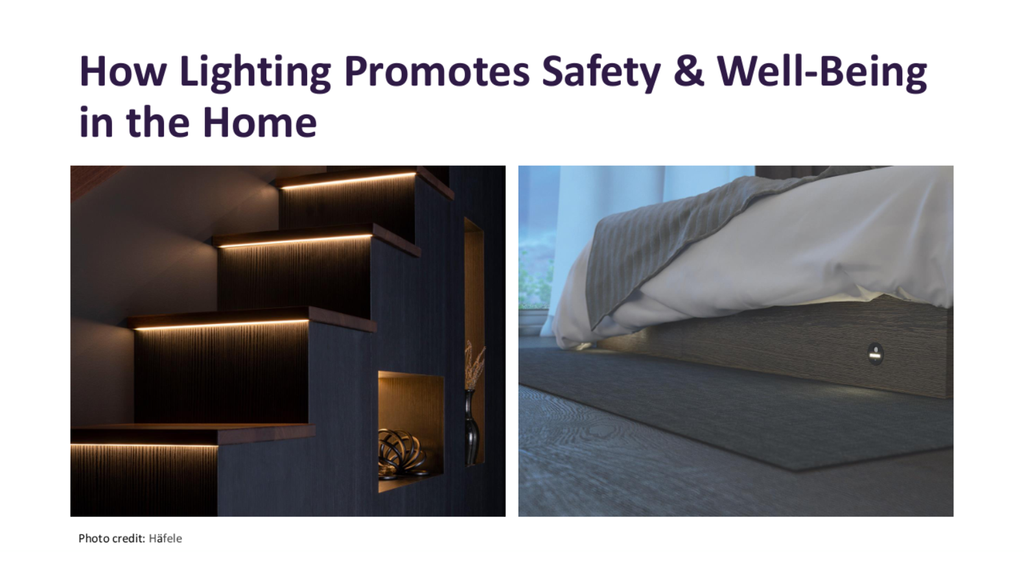
“I have one client who doesn’t sleep well,” Sherman recounted. “He gets up in the middle of the night and wants to be able to get to the kitchen without turning on every light in the home. This solution is perfect. He’s not startled awake, but he can find his way through the house without flipping switches. I think those things are super important across the board, not just for any one specific age group but in general.”
Sherman also uses a shower light for that purpose. “That light can stay on in the bathroom and if my clients have to get up in the middle of the night, the bathroom is illuminated in very soft light and they can find their way without running into something. As we age, the rods and cones in our eyes don’t work as well as they used to and don’t take in as much light. So, we need to be able to provide the light that we’re naturally starting to lose. I think those are some easily achieved solutions for clients — and those are important things. I like to say it’s selling the outcome. It’s explaining what the solution is going to do for you and why it can make a difference.”
She added, “Here is the thing with lighting – especially when it comes to safety and well-being – most people think of these things as very complex and very expensive and that not everybody can afford them. I like having solutions that can work for anyone and that are easy to provide, such as in cabinets. I’m a big proponent of lighting the inside of drawers as well. You can see what’s in the drawer or what’s in that base cabinet or wall cabinet without turning on all the lighting. Those are life’s little luxuries — something so practical and special that just allows you another level of well-being where you’re not struggling with a flashlight to see what’s in the back of a cabinet. And it doesn’t have to be everywhere, just in spots where you know that extra illumination would really help make a difference.”
Hone your listening skills
Finding the perfect lighting solution might not be as obvious as looking at the room or floor plans. “As interior designers, we become sociologists in determining how the client is using the space. We need to tap into the passion of the family to find out who is using each space and what safety features are needed,” Sabatino said.
“Sometimes clients can’t tell you what their problems are. They don’t know how to say, ‘Oh, I need a better beam spread from the lights in my ceiling’ or ‘I’d like some tunable lighting with my undercabinet lights.’ So it’s about understanding how to speak with your clients and hear what their problems are. We can be a great benefit – as a designer who has even just peripheral knowledge of lighting – to be able to explain to the client what’s possible [in lighting]. Then at that point, we bring in a lighting specialist to make all of those things actually work. And it’s a life changer for many people — it’s a life changer for disabled people and for a lot of older folks. And it can be a life changer for anybody who wants to enjoy that space.”
She added, “If it’s an involved project and you’re not comfortable with lumens, lux and foot candles and you’re worried whether you have enough light, seeking professional lighting help is the thing to do.”
Sherman concurred, “You have to know your limits. It doesn’t mean that you’re not smart or that you’re not a good designer. It’s just realizing, ‘I’m responsible for so many other things on the project that I would rather bring in somebody who can guide the process and help me create the best design for the clients and determine how to execute that lighting plan.”
For lighting showrooms, lighting reps, and lighting designers, making your knowledge set available to trade professionals such as kitchen and bath specialists, remodelers, and interior designers is a proven way to grow your business in any economic climate.

