KBB magazine’s recent webinar “The Essential Role of Lighting in Residential Design” provided insight on…
Read More →
KBB magazine’s recent webinar “The Essential Role of Lighting in Residential Design” provided insight on…
Read More →
A long-time High Point Market exhibitor, Ngala Trading will open a Dallas Market Center showroom…
Read More →
New exclusive Consumer Insights Now research shows this is a need-driven generation that likes to…
Read More →
The company says its “residentially inspired” destination will offer an immersive way to experience Kichler.…
Read More →Ronn Torossian of 5W AI Communications tells Lighting News Now what the results of his firm’s new research means for the lighting industry.
A recently released research study examined how ChatGPT, Claude, Gemini, Perplexity, and Google AI Overviews recommend home improvement retailers, brands, and service providers when consumers ask for advice on projects and purchases.
According to 5W AI Communications’ new Home Services & Improvement AI Visibility Index 2026, the AI recommendations didn’t always mirror market leadership. Some home improvement retailers and service providers appear far more often than competitors when consumers ask AI where to shop or who to hire — and the overall ranking may surprise you.
As consumers rely more on AI for advice and recommendations on almost everything, why not home improvement products? For that reason, lighting companies’ and retailers’ visibility across AI platforms is becoming an emerging competitive advantage.
The research analyzed more than 60 prompts across five major AI platforms to measure which companies appear most often in AI-generated recommendations.
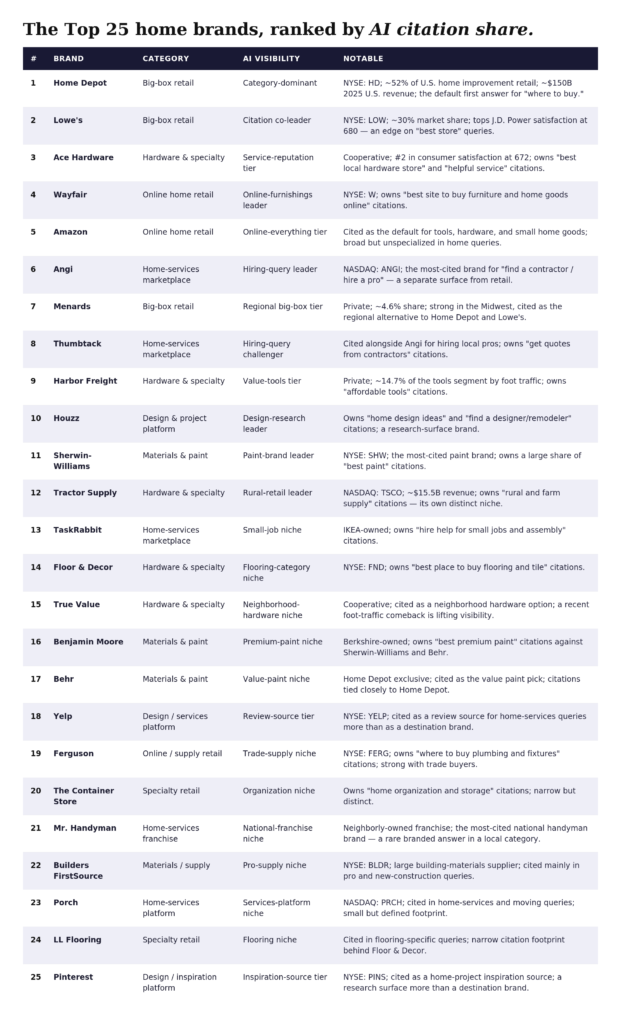
Since retailers, marketplaces, and brands competing for home-improvement dollars are now being researched via chatbox, 5W’s research ranked the top 25 by how often the AI engines name them in an online search.
Lighting News Now spoke to 5W AI Communications founder and chairman Ronn Torossian about what he thinks these results could mean for the lighting industry.
“Just like the home improvement sector, people are turning to AI chatbots to ask questions. Lighting wasn’t a category we broke out on its own in this particular index, but the patterns we found in categories – such as paint – tell you almost exactly what’s happening in lighting right now, because the underlying behavior is the same,” he said.
“In paint, we found that Sherwin-Williams and Behr aren’t competing with every other retailer for a generic ‘best paint’ answer. They each claimed a specific lane and AI treats that ownership as fact,” Torossian explained.
“Lighting works the same way. When someone asks ChatGPT or Google’s AI Overviews ‘what’s the best lighting for a kitchen remodel’ or ‘how do I choose smart lighting for my home,’ the AI isn’t inventing an opinion. It’s retrieving whatever brand, retailer, or piece of editorial content has most clearly claimed that specific question and category,” he stated. “If a lighting brand hasn’t built content that directly answers the questions consumers are actually typing, that brand is simply not part of the conversation — no matter how good the product is on a showroom floor. A brand that has identified itself for kitchen lighting is coming up when people ask for ‘best kitchen lighting,’” he continued.
“Someone does not walk into a store already knowing they want a specific brand of recessed lighting or a particular smart bulb ecosystem. They ask an AI engine what they should be considering, and by the time they’re standing in a store or clicking ‘buy,’ a lot of that decision and thoughts have already been shaped by whatever the AI told them 30 minutes earlier. We saw this exact dynamic across the home improvement categories we measured. The project increasingly starts in the chatbox, not in the store.”
Torossian added, “We think the bigger opportunity for lighting brands is around project-based questions rather than product questions. Homeowners aren’t just asking ‘what’s a good smart bulb,’ but are asking ‘how do I light a kitchen island’ or ‘what lighting makes a small room look bigger’ — which are content questions, not just product spec questions. The brands that answer the ‘how do I think about this’ question – and not just the ‘what should I buy’ question – are the ones that are going to own that AI citation over the next few years. That’s true in every category we’ve studied, and lighting will be no exception.”
The findings
In regard to the overall home improvement category, researchers found that U.S. home improvement retail is one of the most concentrated categories in all of retail. Home Depot commands roughly 52% of the sector by revenue; Lowe’s holds about 30%. Together the two chains account for more than 80% of home improvement store sales — a level of concentration not seen elsewhere in retail.
The 5W AI Visibility Index finds that inside the AI engines, the concentration runs tighter still. Asked “where should I buy supplies for a home project” or “best home improvement store,” ChatGPT, Claude, and Google’s AI Overviews surface Home Depot and Lowe’s first, second, and often almost exclusively. Researchers concluded that decades of editorial coverage, reviews, and consumer consensus made the two chains the assumed answer.
However, researchers also discovered a split in that “where do I buy it” and “who do I hire” are two different questions — and resulted in two different citation surfaces. The home-services marketplaces (Angi, Thumbtack, TaskRabbit) own the hiring query; the retailers own the buying query —and few brands compete across both.
One more decoupling from the Index’s findings: Lowe’s leads consumer-satisfaction rankings despite Home Depot’s larger share. According to the researchers, this gives Lowe’s a citation edge on “best” queries that raw market share does not. Their analysis is that national scale and a deep content footprint win the answer — and the local operator who never built one is invisible on every surface.
Into the weeds: how rankings were determined
5W analyzed more than 60 common homeowner prompts across six primary sub-categories of the home improvement and home-services market, running each prompt five times per engine in clean sessions. Researchers identified which brands AI models consistently surface, which sources feed those citations, and where the biggest gaps sit between scale and AI visibility.
Below are the companies that were evaluated in each sector:
Big-box home improvement
Home Depot, Lowe’s, Menards
Hardware & specialty retail
Ace Hardware, True Value, Harbor Freight, Tractor Supply, Floor & Decor
Online home retail
Wayfair, Amazon home, Ferguson, online supply retailers.
Home-services marketplaces
Angi, Thumbtack, TaskRabbit, HomeAdvisor.
Design & project platforms
Houzz, Pinterest, Yelp home services.
Materials & paint brands
Sherwin-Williams, Behr, Benjamin Moore, and home-materials brands.
What were the query types tracked? Real-world prompts included “best home improvement store,” “Home Depot vs Lowe’s,” “where to buy tools,” “best place to hire a handyman,” “how do I find a contractor,” “best paint brand,” “best site to buy furniture online,” “Angi vs Thumbtack,” and 50+ variations covering retail, hiring, and project-research intent.
Citation sources were also tracked: Retail and consumer editorial (Wirecutter, Consumer Reports, Forbes Home, This Old House, Family Handyman); satisfaction sources (J.D. Power, ACSI); homeowner communities (Reddit r/HomeImprovement, r/DIY); news coverage; and brand-owned content.


As a family-owned independent lighting showroom and distributor, I genuinely appreciate Lighting News Now bringing attention to AI. This is an important conversation, and I want to see our entire industry succeed.
My concern is that many independent retailers rely on articles like this when making important business decisions. AI is evolving rapidly, and it’s important to distinguish between measured data, emerging trends, and opinion. Even 5W, whose research is referenced, describes its findings as directional and notes that AI models change quickly, meaning results can shift over short periods of time.
I was also shocked and disappointed that there was no meaningful discussion of Reddit or other authentic community-driven platforms. In my view, real customer experiences, reviews, and open discussions are becoming increasingly influential in both search and AI-generated recommendations.
The “Top 25 Home Brands by AI Citation Share” chart was interesting, but I think the more important question for independent retailers is: How do we compete? What AI optimization strategies actually work for family-owned showrooms, regional distributors, and niche retailers?
Based on what I’ve seen in our business, I also question how much AI has actually changed market share in our industry so far. AI is clearly growing as a discovery tool, but traditional search, Google Shopping, paid advertising, customer reviews, and trusted brands still appear to drive the majority of purchasing decisions. That’s why I think the title and overall message may overstate where the market is today.
I truly appreciate Lighting News Now starting this discussion. My hope is that future articles continue to prioritize balanced, factual, and actionable guidance, supported by credible sources and real-world industry experience, so independent retailers can make informed decisions with confidence—not feel pressured by attention-grabbing headlines or fear of being left behind.
Stephen, I truly value your opinion and have the utmost respect for Dulles Electric, and the many Dulles Electric employees I have met over the years. You make a good point about the influence that popular sites like Reddit and Quora have when it comes to consumers looking for opinions and doing their own research on companies and products before making a purchase.
AI is a technology that, as you noted, keeps evolving. I’m not sure if you read the article I wrote two months ago using real examples of how lighting showrooms (specifically the finalists of the 2026 Showroom of the Year competition) are using AI tools in their businesses. The article is titled How Are Showrooms Using AI Today? and I have linked to it here. This article contained specific details on how lighting showrooms are implementing AI tools in their business operations right now. Since AI is still in its infancy, or maybe its toddler years, I am interested in sharing relevant information on how companies — lighting showrooms, manufacturers, research companies, and other related firms — are using it so that we can all absorb that information and decide whether it has applications to our respective businesses.
If you would like to write an essay on your viewpoint for an Opinions section, I would gladly share it with readers and invite you to participate. You have great insights and I would be happy to give you a platform to speak to your peers on this (or other) topic.
Lastly, thank you for taking the time to write a thorough and thoughtful response to this week’s AI article. Time is something no one has a lot of these days and I appreciate your sharing an informed opinion on what you just read and thoughts for future perspectives going forward. I don’t know if you will be attending next month’s ALA Conference in Tucson, but if you are, please let me know so we can meet and discuss AI, the state of the lighting industry, or whatever topic you wish.